
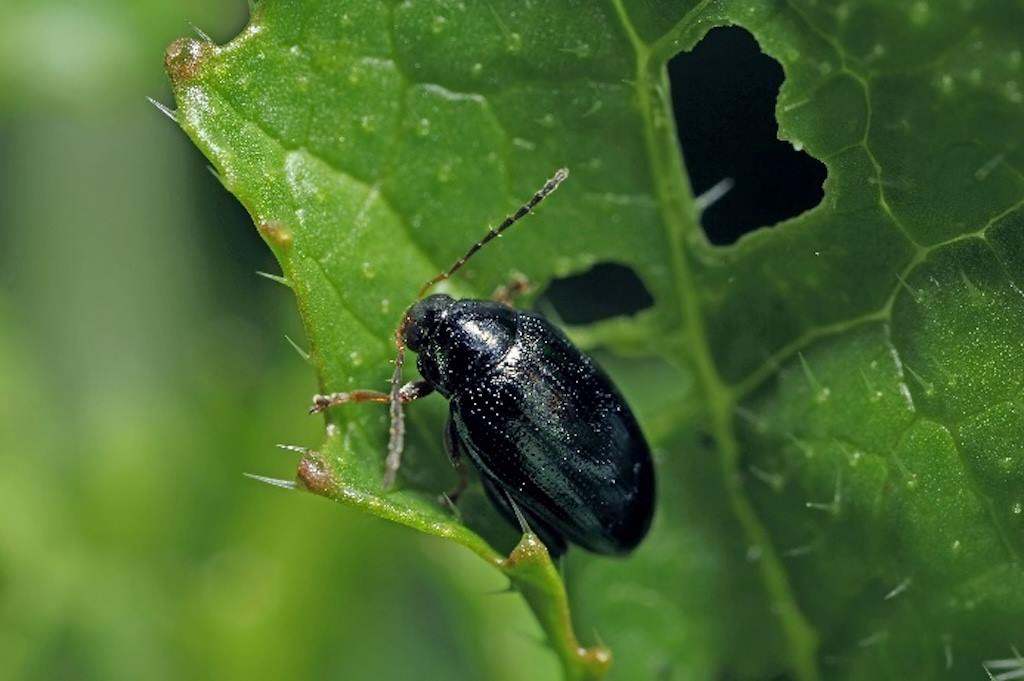
Strengthening oilseed rape during establishment could help reduce indicators of cabbage stem flea beetle (CSFB) pressure and support yield potential, according to a UK trial conducted by ProCam and biostimulant specialist Orion Future Technologies.
The 2025 trial investigated the use of Deneb, a biostimulant containing 4% silicon (SiO₂) and natural plant extracts. The results indicated reductions in CSFB infestation scores and larval counts, alongside improvements in stem development and yield.
Two applications of Deneb were assessed at rates of 0.5 and 0.25 litres/ha.
The infestation score fell from 4.5 in the untreated crop to 3.3 following the 0.5 litres/ha treatment – a reduction of approximately 27%. At 0.25 litres/ha, the score was 3.8, representing a reduction of around 16%.
Larval counts also fell, from six in the untreated crop to five following the 0.5 litres/ha treatment.
Building plant resilience
According to Orion Future Technologies agronomist Mike Stoker, the trial also highlighted a small but potentially significant increase in stem width.
“Silicon helps to improve plant’s natural defences and one of the main takeaways from this trial was stem width, which saw up to a 0.3mm increase compared to the control,” he says.
He suggests that silicon-based biostimulants can also support the development of stronger root systems, potentially helping crops establish and maintain resilience during the early stages of growth.
Yield from the crop receiving the 0.5 litres/ha treatment was reported at 4.9t/ha, representing an increase of around 7% compared with the untreated crop.
Stoker says the results also illustrate that applying a higher rate does not necessarily produce a greater response from a biostimulant.
“Biostimulants have the capacity to improve the natural defences of a plant by accelerating its natural responses. Potentially overloading this by applying more than is needed is unlikely to see any significant gains,” he says.
Based on the trial results, Orion recommends a total target dose of 0.5 litres/ha, either as a single application or split into two applications of 0.25 litres/ha.
Part of an IPM approach
The results are potentially relevant as growers continue to manage the challenge of establishing OSR in areas where CSFB pressure is high.
However, the companies stress that the treatment should not be regarded as an alternative to insecticidal control.
“Deneb should be considered in the context of an integrated OSR establishment strategy rather than as a replacement for CSFB control,” says Stoker.
The trial instead points to the potential role of crop resilience as one element of an integrated pest management strategy, with stronger establishment helping crops cope with pest pressure while maintaining yield potential.
Further work will be needed to establish how consistent the response is across different seasons, sites, varieties and levels of CSFB pressure.
Related news: