
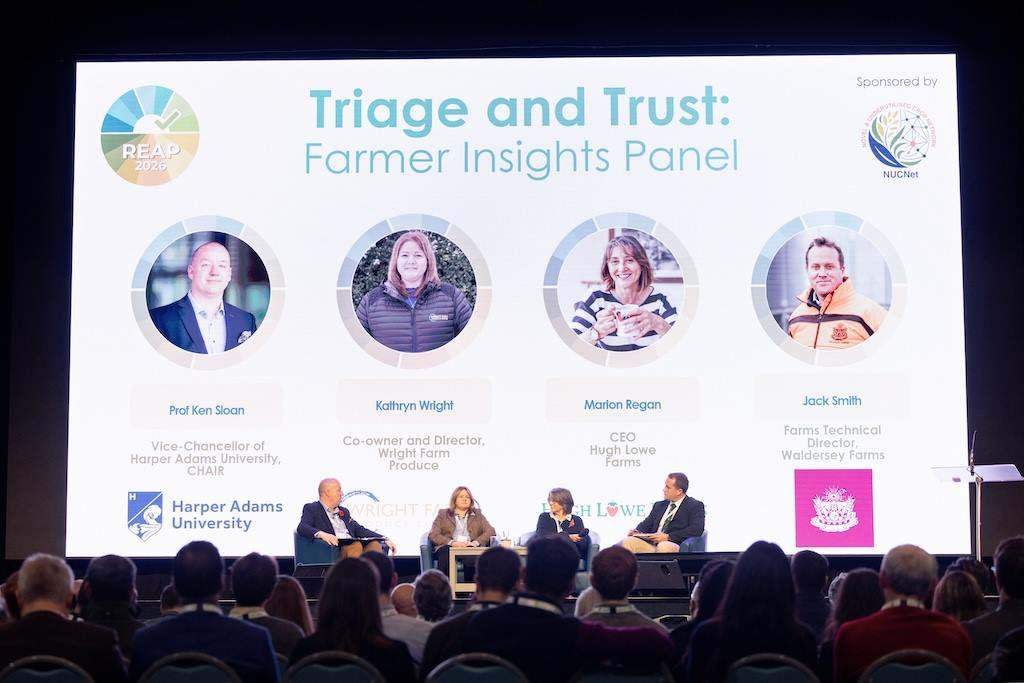
Reliable field performance, a fit with existing operations and evidence of payback should drive technology decisions. Farmers and researchers at Agri-TechE’s 2026 REAP Conference explored what it takes to move innovation into everyday use.
“New technology needs to be good enough to keep the operator still using it at 5pm on a wet Friday in November.”
Jack Smith, Technical Director for Waldersey Farms, put day-to-day usability at the heart of the discussion at Agri-TechE’s REAP Conference. For growers considering a new tool, the test is not simply what it can do in a demonstration, but whether it earns its place in the farm’s working routine.
The conference theme, “From promise to practice: how good is good enough?”, brought together farmers, researchers and technology developers to examine the evidence needed before committing money, time and training.
Start with the problem on the farm
The Farmer Insights panel, chaired by Harper Adams University Vice Chancellor Professor Ken Sloan, described increasing pest and disease pressure, tighter margins and the need to rebalance labour and capital.
These pressures give innovation a purpose, but also make the cost of a poor fit harder to absorb. For a grower, the starting point is the task that needs improving, rather than the technology itself.
Kathryn Wright, of Wright Farm Produce, stressed the importance of seeing equipment in use: “We need to see it working in practice – we want to touch it, feel it and smell it to give us confidence in adopting it.”
The practical questions follow from that: does the demonstration show the job the farm needs done, and is the evidence relevant to its own operation? A compelling concept still has to translate into a workable routine.
Check the fit as well as the payback
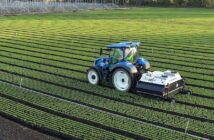
James Miller, CEO of Earth Rover, which has developed the CLAWS autonomous weeding and crop-scanning robot, said farmers want payback on investment, not just the promise of it.
“The technology also needs to fit how the farm already works, and the data it returns has to be useful,” he said.
For a prospective buyer, that puts the working process alongside the purchase price. How will the tool fit existing operations? What will the operator need to learn? What decision will the returned data help make? These are adoption questions, not optional extras.
Miller also highlighted a longer-term concern raised by farmers: whether the supplier would still be in business in five years. Confidence in the company behind a machine is part of confidence in the investment.
Bring research into the existing system
For readers concerned with soils and crop production, the research discussion included using seismology to understand soil compaction, water management and detecting mycotoxins in oats. These were research topics under discussion, rather than a ready-made set of recommendations for farm use.
Jamie Lockhart, Managing Director of Frederick Hiam, challenged scientists on how their research would reach the farm. A consistent message was that farmers need to be involved when the challenge is framed, not just when a finished solution is presented.
Mojgan Rabiey, from the University of Warwick, explained the implementation challenge for precision biological solutions against bacterial diseases: “We need to do a lot of trials to work out how farmers could use our new precision biological solutions against bacterial diseases – we want to apply it using the existing routes farmers use already.”
That emphasis on existing application routes matters. The question is not only whether a treatment works, but how it could be used within the systems farmers already operate. The trials still need to establish that practical fit.
Match the evidence to the commitment
Waiting for a perfect dataset can delay progress, but moving ahead still requires evidence relevant to the decision. Keynote speaker Professor Anjali Goswami, Defra’s Chief Scientific Advisor, warned: “Not every evidence gap is important”.
Professor Cristobal Uauy, Director of the John Innes Centre, asked: “Is the next step proportionate to the effort needed to get there?” He described “good enough” evidence as the evidence that enables the next step in a technology’s journey.
Applied to a farm decision, that distinction is useful: deciding whether to investigate a tool further is not the same commitment as buying it. The evidence sought should reflect the scale of the decision being made.
For growers, the conference discussion points to four questions before adoption: what problem will the technology solve; can its performance be seen in practice; will it fit the operation and return useful information; and is the evidence strong enough to justify the commitment?
Continuous improvement, rather than delayed perfection, was the recurring theme. But improvement has to be practical enough to keep the operator using the technology when conditions are less than ideal.
David Coop, Managing Director of Elsoms, offered the closing principle: “make the evidence you seek proportionate to the decisions you need to make.”
Related news: