
Hot dry summers, milder autumns and a deeper understanding of cabbage stem flea beetle behaviour have seen the drilling of winter oilseed rape delayed in recent seasons. As the window has moved, the questions around timing, plant vigour, variety selection and crop management have become more, not less, important.
The window has moved
Craig Padley, who runs NPZ UK’s trial sites in Cambridge and Wisbech, says the old drilling calendar no longer holds.
“It used to be that we’d drill by the 10th September, but with climate change that’s no longer relevant,” he says. “I would be happy to drill during the third week of September. The plants are quite small going into the winter, but they have eight leaves and a reasonable root diameter and length, so they survive the winter without a problem.”
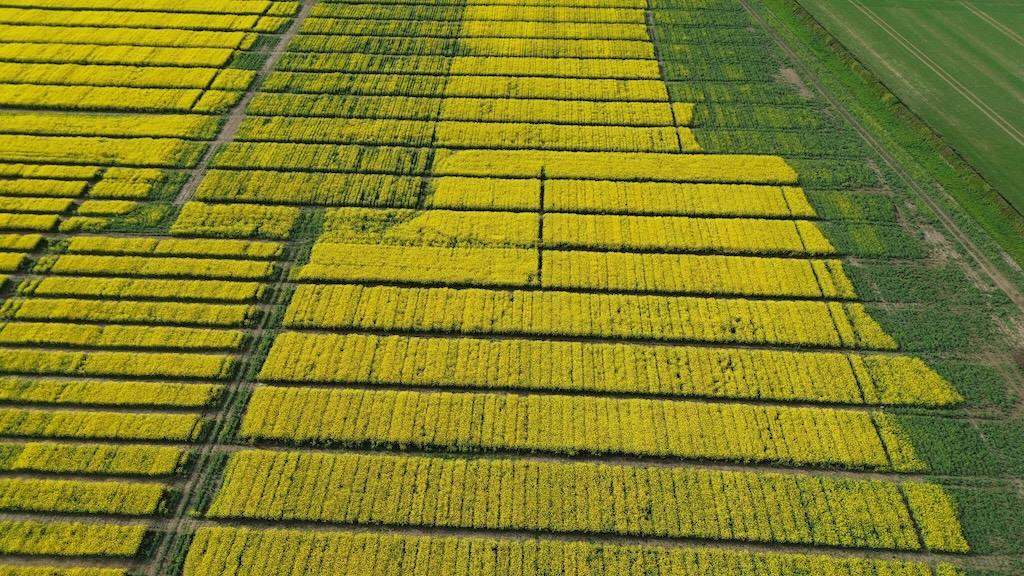
This year’s dry start to the autumn brought the trial drilling into line with farmers, most of whom were unable to use the earlier slot. The company’s early-drilled trial went in on 20th August, just ahead of the rain because the ground was in Craig’s words, “like concrete.”
A late-sown crop can hold its own
NPZ UK’s own trial data for the previous season points to late drilling not being a gamble. Last year, the late-sown plots averaged 4.68t/ha, against 4.37t/ha for the crops drilled on the usual date.
The difference, he says, is largely down to spring cabbage stem flea beetle larval damage.
“Earlier-drilled crops, with the warmer soils, had on average about 20 larvae per plant; the late-sown plots escaped them,” he recalls.
The company is feeding this and other information into the industry-wide OSR Reboot programme.
Why timing matters at the plant level
Craig points to NPZ funded research by Professor Ute Kropf of the University of Applied Sciences in Kiel into day-degree requirements to explain why a later-drilled crop develops differently.
”Plants need around 150 day degrees to germinate and put out their first cotyledons, then roughly 120 to 150 day degrees for each pair of leaves,” he says.
“Once you pass about 1,000 day degrees the plant starts to differentiate, meaning that the flower buds begin developing.
“With an early-drilled crop it races through the differentiation stage, passing 1,200 day degrees quickly and moving into its reproductive phase.
“That means that stem extension starts before the onset of winter. At this point differentiation stops and the maximum number of potential flowers is set.
“After that, the reduction phase of these potential flowers begins. With plants focusing nutrients on lengthening the main stem, some potential tillers and buds are dropped before they can flower.
“With a later-sown crop, 1,200 day degrees is not passed before winter sets in and bud differentiation carries on into the spring.”
That, he adds, is where plant growth regulators have their part. “We’ll apply them when the crop hits four to six leaves to hold the plant for two to three weeks,” he says.
Related news: