
Early GB planting intentions for the 2017 harvest suggest a small fall in the total wheat area. Spring barley is expected to rise again significantly, whilst winter barley falls. Oilseed rape is projected to decline marginally and pulses are also expected to fall in area from the 2016 harvest, report Graham Redman and Joe Scarratt from The Andersons Centre.
The AICC / Andersons Early-Bird Survey (EBS) was undertaken during the autumn to assess national cropping intentions. The survey was undertaken by The Andersons Centre incorporating the Association of Independent Crop Consultants (AICC).
A team of 35 agronomists took part in the survey to gather data from 262,500 ha of arable land across all regions of Great Britain (GB) to establish cropping changes on individual farms as a representation for the national change in cropping. In previous years, the survey has been an accurate forecast of actual harvested areas as demonstrated by previous comparisons to the June Census data.
The survey is based on measuring cropping change from the harvest just completed to the current growing season and plans for late autumn and spring drilling. Each farm is individually selected as those with no net change to their arable area, or where there is change, it can be reconciled within the rotation. In other words, because the survey measures the percentage change of each crop, the total crop area has to remain unchanged overall. Using the results from DEFRA’s UK June Survey, it is then possible to forecast crop areas for harvest 2017.
Autumn drilling conditions have been good in most parts of the UK, albeit lacking moisture in certain areas. Nevertheless, it is suspected that all planned winter plantings will have been possible due to conditions remaining dry into late October, therefore helping those following root and maize crops. Based upon history, under such conditions, the UK normally sees a high proportion of autumn cropping. This is, however, changing, as has been the case for the past two seasons, with a continued greater focus on spring cropping.
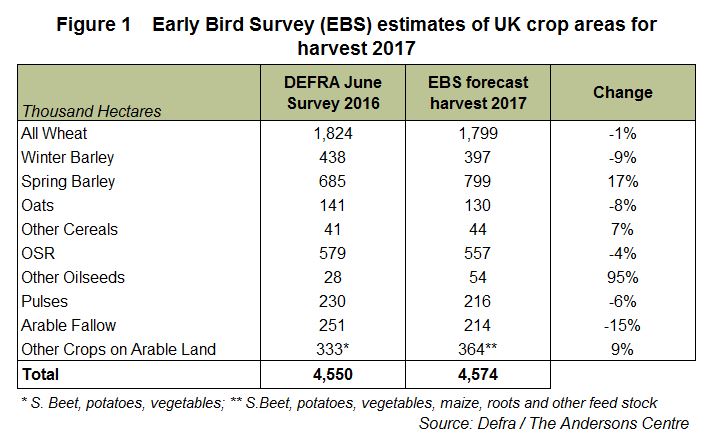
The wheat area is forecast to fall very marginally by 1% to 1.8 million hectares. This includes spring wheat, which anecdotally (with a greater emphasis this year, it is worth noting) is reported to be rising within the total wheat area. The forecast wheat area for 2017 equates to an area 4% below the past five year average. Despite good drilling conditions, grass-weed challenges are placing a limit on the winter wheat area for most farms.
The winter barley area is expected to decline by circa 10% whilst the area of spring barley is anticipated to continue its increase, with the 2017 area forecast to be almost 17% higher at 799 thousand hectares. For spring barley, aside from 2013 which was driven by poor weather conditions in autumn 2012, this would be the highest area of spring barley on records going back to 1997. The largest increases in spring barley are in the areas most affected by blackgrass (i.e. little change in the far south and Scotland). However, if the price spread between wheat and barley continues, there could be a switch of some of this area into some more spring wheat. Winter barley yields for 2016 were generally poor which, when combined with the added grass-weed control benefits of spring cropping, are likely to be turning many towards spring varieties.
The area of oats for the past four years has been above historical averages. The area for 2017 is projected to reduce by 8% to 130 thousand hectares. Although a cheap crop to grow and profitable for many, the grass weed challenges (with little or no chemistry to fight blackgrass/ryegrass) limit the area which can be grown. This is despite reported growing market demand.
The oilseed rape area (OSR) is showing a further decline of 4%, which equates to a projected oilseed rape area for 2017 of 557 thousand hectares. This is a forecast net area, accounting for abandonment, which has been estimated through discussions with agronomists. The net area planted to OSR represents the lowest since 2004 and is the fifth successive year that the area has fallen. Whilst anecdotally many will have expected a greater reduction in oilseed rape area, key regional differences do exist. In the East there is a dramatic decrease (down 28%) due to flea beetle difficulties and a lack of moisture making establishment very difficult. Many areas have been written off and either sown with second wheat or destined for spring barley.
The survey carries a very accurate track record and only represents a snapshot of both actual plantings and more tentative intentions at a given point in time. Therefore the results should be interpreted carefully. The reliability of the larger crops is greater, as are the winter crops as they are actual plantings compared with planting intentions for spring crops.
Using the forecast of crop areas for the 2017 harvest we can expect to see the wheat area fall slightly from 2016, whilst spring barley and other crops on arable land gain considerable area mainly at the expense of winter barley, oilseed rape and pulses.