
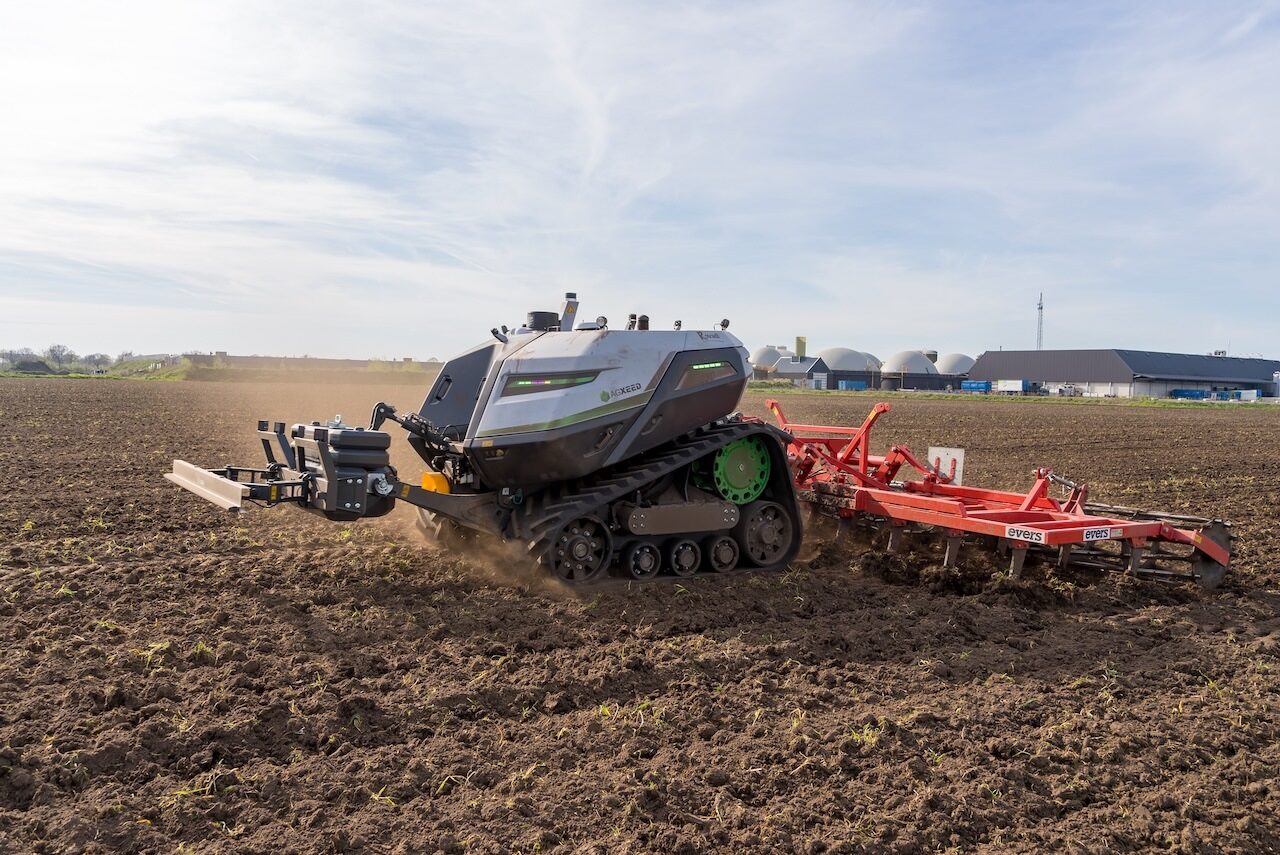
AgXeed claims <30kPa ground pressure for its AgBot T2 7‑Series. Netherlands farmers says soil protection and labour pressures both influenced its decision to commission the first unit.
Landgoed de Princepeel has commissioned the first AgXeed AgBot T2 7‑Series, a tracked, autonomous power unit the estate expects to use across 500 hectares of arable land, with soil protection cited as one of the key drivers behind the investment.
The machine was commissioned at the end of March. The estate says it is looking for a more sustainable way to organise fieldwork—improving machinery utilisation and making jobs easier to schedule in narrow weather windows—while also reducing reliance on driver availability during peak periods.
AgXeed says minimising soil compaction is a core design goal, using a track undercarriage with a large contact area. Manufacturer figures list claimed ground pressure of less than 30kPa and an adjustable track width of 1.5–3.2m. In practice, that combination is aimed at keeping field operations moving when conditions are marginal and at spreading load more evenly on heavier ground.
The T2 7‑Series is built around a 230hp (170kW) diesel‑electric powertrain, with a Deutz 5.2‑litre Stage V engine driving a generator. Hydraulics are rated up to 170l/min at 210 bar and the unit can be specified with a mechanical PTO (1000rpm), with AgXeed positioning the platform to work with standard implements via linkage, hydraulics and PTO—covering everything from cultivation to drilling.
Delivery and commissioning were carried out by LMB Rovadi (Ysselsteyn). AgXeed says planned autonomous operation is supported by sensors such as cameras and lidar, plus geofencing and remote monitoring.
For soil-focused operators, the wider point is that autonomy could help match operations more closely to optimum soil conditions—by enabling work to start when conditions are right—while the tracked running gear aims to limit the penalty when soils are vulnerable.
Related news: