
- Angus Gowthorpe, from Approach Farm, near York, is the winner of the 2024 RASE Natural Capital Award, which celebrates farmers striking the balance between sustainable agricultural practices, ecological enhancements and financial resilience. The following case study provides insight into Angus’s reasons for switching to a regenerative system, his farming practices and how he is now accessing a premium for his regeneratively produced wheat.
Located in the Vale of York, Approach Farm is a 450-acre arable and beef farm, which includes 30 acres of rented grass. Of the total acreage, there are 100 acres of grassland and 330 acres of arable. Angus also manages an additional 100 acres of arable land which is under a contract farming agreement.
The majority of the grassland is in herbal leys, which supports a 40-cow pedigree Saler suckler herd. From this, the heifers are either retained or sold for breeding and between six and ten pedigree bulls are sold per year.
On the arable side of the business, winter wheat, winter barley, oilseed rape, spring oats, spring linseed and spring beans are grown, plus occasionally some forage maize. Everything is grown on a regenerative system and has been for the last 11 years.
The farm is in a Countryside Stewardship mid-tier agreement and also Sustainable Farming Incentive (SFI) 2023, with a mixture of in-field and field boundary options.
It was a combination between the need to make the books balance and realising that the soils were deteriorating which led to the switch to a regenerative system on Approach Farm.
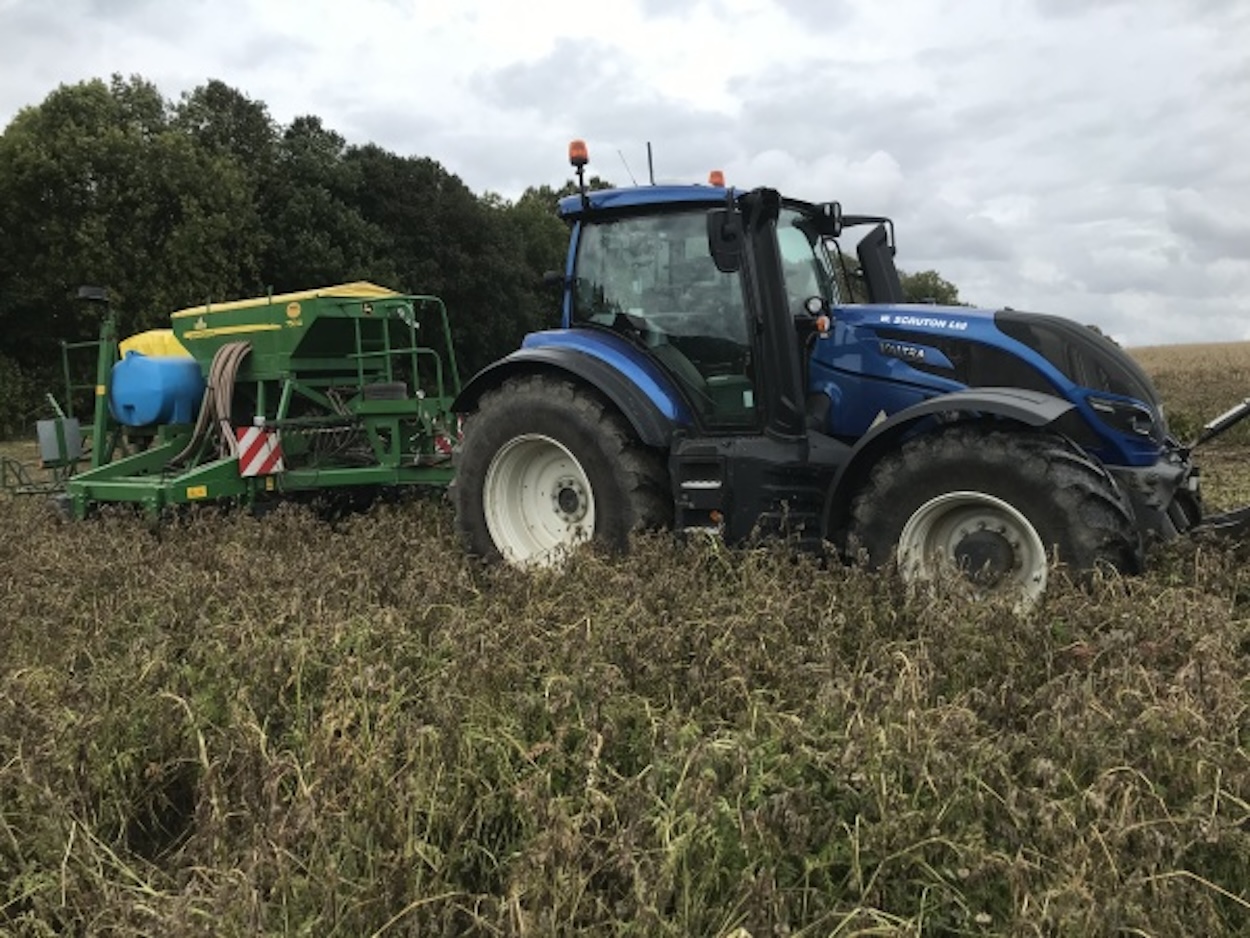
As the farm was not of a size to afford fulltime labour, everything had to be done by Angus, plus some help from part time staff. Reducing the labour requirement associated with the establishment of crops, particularly as it had been taking an increasing amount of effort to achieve a good seedbed, was identified as a way to improve financial viability. Angus initially decided to use a strip till, which he did for two years, before switching to using a disc drill, which he has used ever since.
Until the closure of the British Sugar plant in York in 2007, sugar beet had been a big part of the rotation on Approach Farm. Since going down the regen route, the rotation has been expanded to include more broadleaf crops. Angus explains that a maximum of two consecutive cereal crops is grown before a break crop. This helps prevent the build-up of grass weeds and issues with cereal cyst nematodes. Cereals are then followed by a broadleaf crop which can be beans, oilseed rape or linseed. Cover crops and catch crops are now used at every opportunity and with SFI, a legume fallow is now an annual rotation option too.
Angus explains that he has developed his own standard mixture for cover crops. His number one rule is no cereals, partly because a huge amount of cereal is grown in the UK, so from diversity of plants perspective he chooses to include other things, but also because presence of cereals would increase the burden of cereal cyst nematodes. The standard mixture includes a selection of legumes, to build as much biological nitrogen as possible, plus other plants to provide a variety of rooting depths and a mix of winter hardiness. Ideally, the vast majority of the cover crop dies over winter, which opens up the soil for natural drying and reduces the amount of glyphosate needed.
Angus has been using blends of varieties in his cereal crops for the past 10 years, which has been beneficial in terms of reducing disease burden. The current winter wheat mixture is a blend of eight different varieties of group 2 or group 4 hard wheats, all with different parentage. The current winter barley is a blend of two varieties.
Coinciding with the switch to no-till drilling and the introduction of cover cropping, Angus has reduced the use of nitrogen fertiliser by two thirds on the arable and eliminated it on the grassland. In addition, the farm no longer uses any seed treatments, insecticides, bagged P or K fertiliser or plant growth regulators, and has almost eliminated fungicide use.
Instead, biologicals are used to enhance plant nutrition and health, as healthy plants do not succumb to disease. Angus shares that he uses a biological down the spout on the drill, which boosts the nutrition from the soil, boosts plant health and increases the accessibility of phosphates. Another set of biologicals is used as an ear wash spray, which prevents fusarium infection.
Related news: