
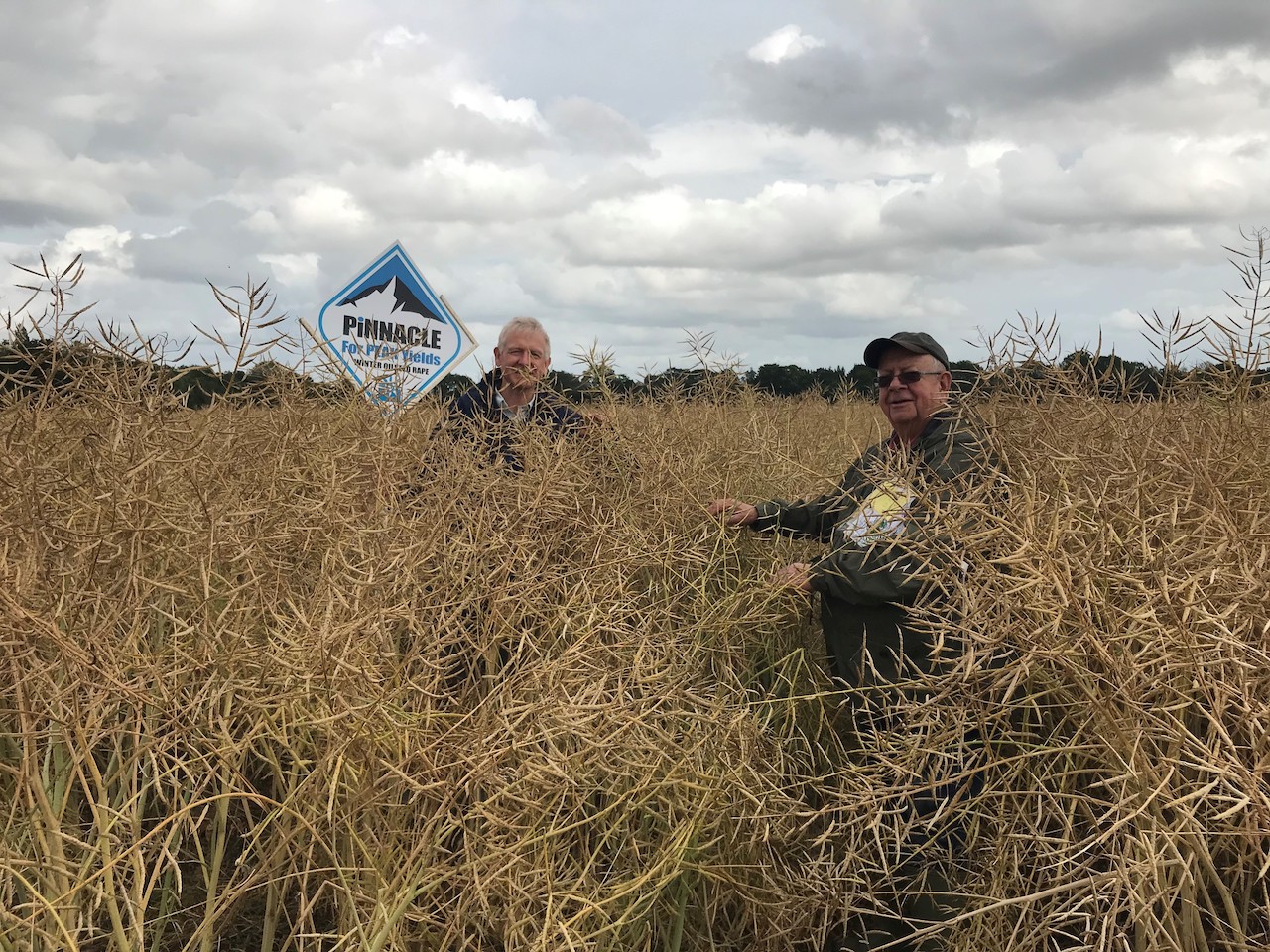
Pinnacle is the top performing conventional rape variety in terms of gross output and treated yields, for the second year running. It is this that has resulted in this variety being selected as a control variety in the AHDB trials for 2025. Neil Groom, general manager for Grainseed, reports that their conventional winter oilseed rape variety has produced the highest gross output each year over the four years of official trials and it is fully recommended for the whole of the UK, in the east/west and in the North.
This is not just because it is Number 1 in yield, but also because it has a top-ranking agronomic profile. It has good seedling vigour in the autumn, helped further by the seed treatments, Integral Pro and Sylas. Neil points out that Pinnacle’s vigour has been shown repeatedly to equal or exceed that of some hybrids. “In my experience vigour is a feature of the individual variety, not just whether it is a hybrid or a conventional variety.” he says.
In the National List trials Pinnacle had the same autumn vigour and establishment data as Campus, which has been seen by growers as quick to get away and easy to manage in the past. “But with 5% more yield than Campus, Pinnacle has become the new number 1 conventional variety for growers.” Neil says.
Pinnacle has very good resistance to lodging (8.0) at flowering time which allows good air flow within the crop canopy, reducing build-up of disease and reducing yields. “When a crop lodges, it cannot intercept sunlight efficiently, photosynthesis is reduced and so is yield. Pinnacle has been bred for clean stems that keep green for longer, helping build yields further. It also has top rating for stem stiffness (9.0), making harvesting easier as the crop stands well and the flow of crop into the header is better and quicker. It is a medium height variety.
Pinnacle is late to flower (having a 5 rating, later than other control varieties) reducing the risk of flower loss due to frosts which we saw this spring. But it is still a medium when it comes to grain maturity (rating 5), allowing crops to be harvested before first wheats are ready to cut, easing workload bottlenecks on farm.
Pinnacle was bred in the Cotswolds by Mike Pickford, who has more experience in breeding rape than anyone else in the UK (over 50 years) and is fully independent. In the rape market he is the only plant breeder focusing on the breeding of conventional oilseed rape varieties nowadays. Most other breeders are focusing on hybrids.
“I aim to breed varieties that are suited to UK conditions. My breeding philosophy is to improve individual yield components, such as increasing the size of the seed. Pinnacle has seed with a thousand grain weight between 6.5 gms to 7gms compared to Campus at 5 to 6 gms. I also aim for a longer period of yield building, keeping stems greener for longer: this is a feature of Pinnacle.”
The disease resistance profile of Pinnacle is robust and reliable with a 7 for Light Leaf Spot and Intermediate for Verticillium wilt. “The disease data in the ADHB lists is generated by inoculated disease nurseries where everything is done to encourage disease, this is not what happens on farm,” Neil observes.
Of all the diseases, Light Leaf Spot is the most difficult to control on farm as it is polycyclic throughout the growing season. Pinnacle has very good resistance rating of 7, which is the highest on the Recommended List.
New to the AHDB list last year was an overview of Verticillium wilt resistance. “The rating for Pinnacle is ‘Intermediate resistance’. It was as good as the resistant control variety Catana in ADHB trials.” states Neil.
Although the Stem Canker rating of Pi Pinnacle is a 4, Neil is not concerned. “Typically, growers will apply an autumn fungicide for phoma and LLS, a spring fungicide for LLS and a flowering fungicide for sclerotinia so it is rare to observe cankers in farm crops as the control from applied fungicides is very good”.
Having a good all-round disease resistance package can save time and money but do not forget that growing a resistant variety against Verticillium wilt is the only way to minimise this disease, as there are still no approved fungicides,” he says.
Grainseed are also part of the Reboot OSR campaign spearheaded by United Oilseeds and AHDB where breeders and scientists are collaborating to improve the understanding and control of Cabbage Stem Flea Beetle. At the Cereals Event 10 top tips were highlighted based on practical farm evidence from research.
With only one-half of the area of WOSR now grown compared to 10 years ago, the UK is relying on imported oilseeds to crush, threatening our food security, and lowering our food standards so improving the prospects of growing OSR on farm is important believes Neil.
“Our first goal is to improve the establishment of rape crops and then to build plant size so that they can cope with any larval load in the spring” explains Neil.
““If growers are looking to reduce costs as much as possible, growing a high performing conventional variety can enable you to do this. With a conventional you can save your own seed which is a significant cost saving. Farmers know how vigorous and high yielding Pinnacle is and the majority who grew it last year and the year before, will be growing it again this year.” says Neil Groom.
Related news: