
Herefordshire farmer Mark Wood has been hosting on-farm try-outs for the past three years as part of his role as an AHDB Monitor Farm host.
He manages the farm at JPF Clay Farms in Fawley, halfway between Hereford and Ross-on-Wye, which has been home to debates and discussions on a whole host of topics chosen by the Monitor Farm group.
At the penultimate Monitor Farm meeting the group of local farmers heard the results of the on-farm try-outs, including work on compaction, cover crops, crop profitability and precision farming.
Tyres and compaction
Mark farms on sandy loam soils that suffer from compaction easily. He found that he was getting a lot of damage from vehicle wheelings, especially at harvest.
He said: “The sandy loam soil is unforgiving. If you make one mistake, it lasts all season and beyond.
“We needed to look at our tyres because we saw the damage we were doing.”
In April 2015 the Monitor Farm group looked at tyre pressures and types, and as a result changed the trailer tyres.
The new drilling tractor runs on 710/60 R22.5 tyres, with pressures varied according to the load. The two main grain trailers run on 560/45/25 tyres.
“You can see the differences very visually. It also takes less horsepower to pull the trailers with the new, wider tyres.”
A quick comparison this January between the old trailer tyres, which were standard lorry super singles, and the new wider flotation, low ground pressure (LGP) tyres found that the new tyres did cause less compaction in a field of cover crops. With the trailers loaded to 2.4t, (they are 12t trailers but ground conditions did not allow more) and the tyres both at their recommended road pressures, the wheelings on the narrower tyres resulted in 300psi resistance on the soil penetrometer, whereas the wider tyres led to just 200 psi. Depth of the damage was half the depth with the LGP tyre
Mark said: “The Monitor Farm has been brilliant for raising our awareness on wheel loads and axles. We’d never have considered that three years ago. There’s a lot more thought that goes into it now.”
Cover crops
For Mark, the most important consideration is that any cover crops grown contribute to the overall profitability of the farm, preferably through the following crop. The aim of cover crops for Mark is to capture nutrients and improve the soil structure.
The team at JPF Clay have grown a cover crop try-out for three years. They have learned that the most important consideration is that it does not negatively affect the following crop which is the thing that puts the money in the bank. Secondly design your cover crop to meet your aims, whether that be nutrient capture, bio-fumigation, soil structure or another purpose.
This season his cover crop was sown in late August with leftover bird cover seed and a mustard mix. It was established with a Horsch drill into stubble, and tillage radish was spun on with the slug pellet applicator. It was then rolled. The soil in this particular field is sandy, and prone to leaching.
Mark paid a total of £10/ha for the seeds, and it cost £65/ha to establish.
Emily Smith, Knowledge Transfer Manager, said: “We’ve been finding, from farmers’ experiences, that it’s important to consider soil types when thinking about cover crops. It’s also vital to look at the long-term benefit, not just any single year.”
The group found a good diversity of worms under the current cover crop, with different species and ages represented.
Worms At Hereford
Mark said: “Next year I will try to establish the cover crops slightly cheaper with the use of a stubble rake, and may also add a small amount of N to boost early season growth. We are getting very little carryover of nutrient from the preceding crop.”
Another question Mark and the group had was whether first wheat was the most economic crop to grow on his shallow soils, which have a high stone content and low resilience to weather extremes.
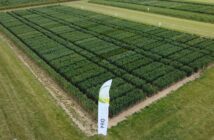
To test his ideas, Mark grew three different crops – first wheat, hybrid barley and triticale – for comparison, on fields that were as similar as possible and all following oilseed rape in the rotation.
They were all grown for best return, with all inputs and outputs costed. All fields were drilled during the last week of September with variable rate seeds and base fertiliser. The crops were sold at the best price possible.
Precision farming
Mark and the team at JPF Clay looked at precision farming and variable rate seeds and applications in order to address rising input costs, variation in soil types, to even up outputs and to exploit advances in technology and accessibility.
“Here in Herefordshire we can have an average of six different soil types per field, even though we have very small fields, so variable rates may well be very important to us.
“The big question, being asked through monitor farms was, did variable rates pay? It’s hard to say whether our yields have increased to cover the costs, because we haven’t got yield maps to compare it to in the past. However, even if we did, it would be difficult to attribute any increases solely to variable rate applications, with the differences each year due to climate and other factors.”
The group heard how it would cost Mark £7.10/ha per year, over four years, to renew the software licenses and do all the soil tests needed for variable rate applications. This would mean that, if wheat was at £120/t, Mark would need to produce 60kg extra wheat per hectare per year to pay for it.
“I’ve learned that, with precision farming and variable rates, it does take time to set up, but it can save time later. It has shown us areas for further exploration, for example that we’re losing money on the headlands.”
The final meeting at the Hereford Monitor Farm meeting will be on 16 February. To attend, contact Richard Meredith, richard.meredith@ahdb.org.uk or 07717 493015.