
The move to a new site for the third year of the Hutchinsons Fenland Potato demonstration is already generating interesting results that will help shape future agronomy.
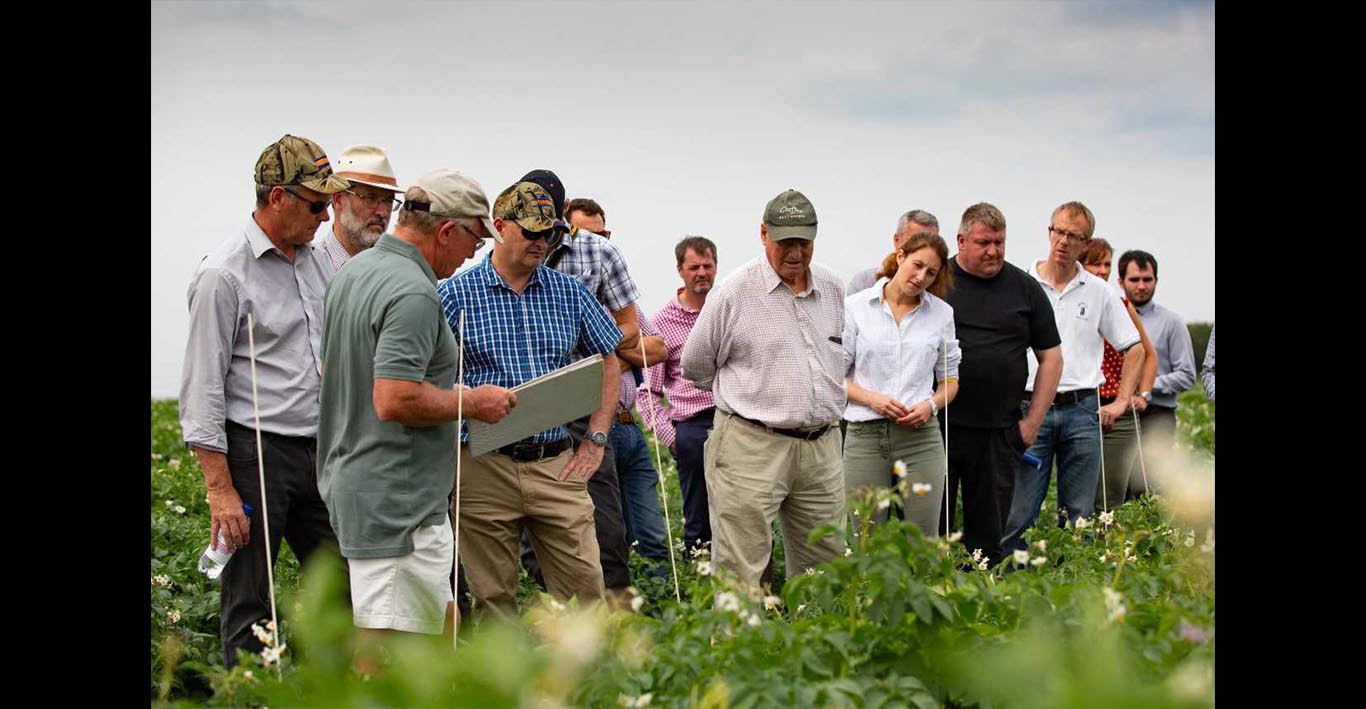
Integrated Potato Cyst Nematode (PCN) management, post-emergence herbicide crop safety, and seed age & planting date trials again took centre stage at the open day on 17 July, hosted at AL Lee Farming Company’s Folly Farm near Ely.
Parts of the site were under higher PCN pressure than last year’s venue, nearby Friesland Farm, which meant clear differences had already emerged in the varietal resistance and tolerance trials, John Keer of Richard Austin Agriculture said.
Pre-planting assessments found an initial PCN count of up to 164 eggs/g soil, all of which was the Globodera pallida species. “It’s a slightly more mineral soil than the rich black Fenland at Friesland Farm, so doesn’t offer as much resilience to the effects of PCN damage, which is helping highlight differences in our trials.”
Some 18 varieties were planted on 15 April and each was being compared with and without a nematicide (fosthiazate).
“PCN levels are consistently high across the trial area, which is bringing out differences in variety tolerance. We will take crops to harvest to see how yield is affected,” Mr Keer explained. “By measuring PCN populations pre-planting and after harvest, we will also be able to see how varietal resistance, or lack of, affects PCN multiplication in the soil.”
Initial observations reinforced the view that tolerant varieties were generally those with more vigorous growth that produced larger root systems better able to withstand feeding by larvae, he said. While tolerant varieties could withstand feeding damage and still yield well in the presence of PCN, without resistance, they would let cyst numbers multiply over the season.
“Tolerance and resistance are not linked. PCN still feeds on the roots of resistant varieties and those with low tolerance can therefore suffer quite a lot of damage, even if the crop’s resistance prevents new cysts forming.”
At Folly Farm, varieties that had so far showed good PCN tolerance (i.e. little visible difference between treated and untreated plots) included Arsenal, Brooke, Cara, Performer, Rock, and Royal. In contrast, Maris Peer, Innovator, and Sagitta exhibited more noticeable effects indicating lower tolerance.
“The really interesting detail will come when we measure the yield impact and see how G. pallida varietal resistance affects final PCN count after harvest.
“The ideal would be to grow a variety with good PCN tolerance, and resistance to both species, that is also accepted by end users. That’s not always possible, but the judicious use of resistant varieties and other integrated controls could buy flexibility to grow non-resistant varieties where necessary.”
The third year of the crop safety from post-emergence herbicides trial again showed noticeable differences between varieties, Hutchinsons root crop technical manager Darryl Shailes said.
The impact on vigour and necrosis/ chlorosis of four different post-em herbicides on seven varieties had been assessed, and results generally supported findings from previous seasons.
“There’s always potential for some crop damage from post-emergence herbicides, but the extent is variety-specific.”
For example, bentazone had been consistently aggressive on Agria, causing noticeable scorch. Markies also suffered more scorch from bentazone than in previous seasons, potentially because the crop was under stress at the time of application, he said. In contrast, Innovator was more tolerant of bentazone, but was susceptible to damage from metribuzin. Other varieties such as Performer and Royal showed minor effects and generally grew away well.
“We set up the trial to look at yield effects across the varieties to see if scorch or vigour reduction has a significant effect. Unfortunately, plots got waterlogged twice so establishment wasn’t as we would have liked so it will difficult to draw conclusions in terms of yield.
“However, this works gives us greater confidence to make recommendations to our clients, even where applications may not be supported by herbicide manufacturers,” Mr Shailes added. “Manufacturers do very little research on varietal impact and when they do it tends to be ultra-cautious.”
The seed age and planting date trial, run by Farmacy’s Stefan Williams, further examined how differences in planting date and chronological age of three Scottish Maris Piper seed lots (one chitted and two non-chitted) affected marketable yield and quality. “Old” seed was seed crops with a 50% emergence date of 15 May, whereas “young” seed was 5 June.
Test digs reinforced previous work showing that younger seed produced more tubers than older seed and that chitting seed before planting produced fewer tubers across all three planting dates (15 April, 1 May and 16 May). Plots will be taken to harvest to see the effect on yield and tuber size.
“Buying the right seed lot and protecting chits during planting makes a big difference,” said Mr Williams.
“Older seed, consistently over the last three years of trials has produced 20% fewer tubers than ‘younger’ seed. Targeting ‘older’ seed stocks means we are reducing our tubers per plant ratio, therefore achieving a higher proportion of 75mm+ tubers for chipping and processing.”
Mr Williams continues: “When I first came to the farm five years ago, growing chitted Maris Piper seed was quite common for later planting. But it can be hard not to damage chits even on modern planters. Our work shows in some cases only 20% of chitted seed planted remains undamaged. Potentially you can double tuber number where the chit hasn’t been knocked off compared with one that has.
“If we don’t chit seed, it can be challenging to spread planting dates and our trials suggest if we were to change to mid-May planting of unchitted Piper, we could have higher numbers of smaller potatoes. If the business stays with chitted seed, we need stronger chits and gentler handling to protect them and avoid tubers wasting energy producing chits that get knocked off.