

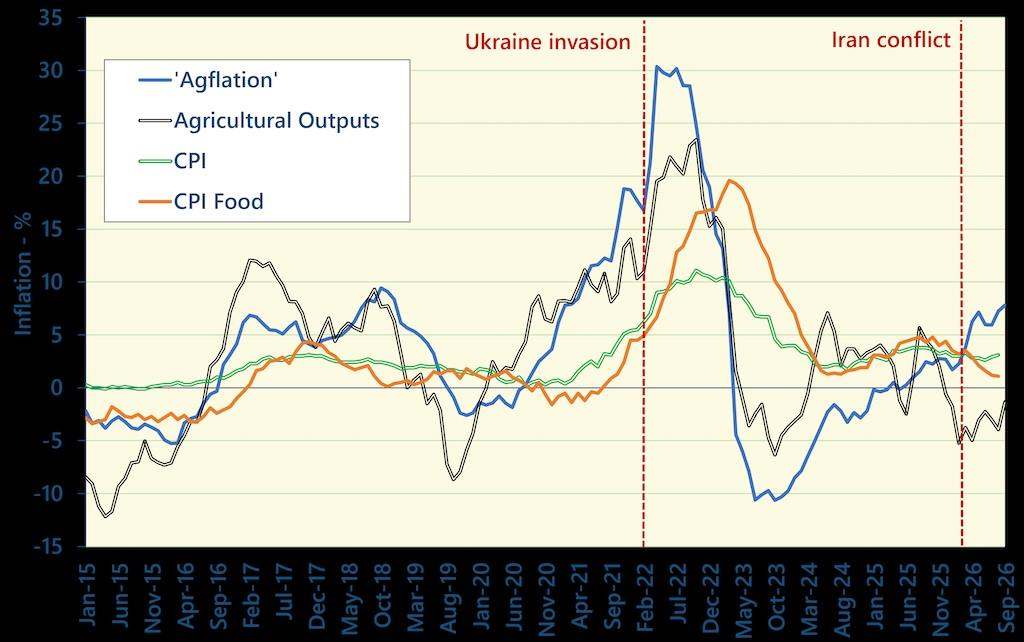
UK farm input costs are rising at more than twice the rate of general inflation, while agricultural output prices are falling, according to the latest estimates from The Andersons Centre.
Its Agflation index reached 7.8% in the year to September 2026, up from 7.2% in August and 1.7% in January. This is the highest annual rate since early 2023 and compares with headline consumer price inflation of 3.1% in August.
Fertiliser is among the biggest contributors to the increase, with prices estimated to be around 35% higher than a year earlier. Energy and lubricants costs have risen by more than a quarter, while contractor charges are up 11% and wages 5%. Feed prices have increased more modestly, by around 3%.
At the same time, agricultural output prices are estimated to be 1.3% lower than in September 2025. The resulting gap between input and output price movements exceeds nine percentage points, while overall farm input costs are now around 40% above 2020 levels.
The figures come as growers begin setting budgets for the 2027 season, with implications for fertiliser purchasing, crop choice, machinery use and the timing of field operations.
For arable businesses, the rise in fertiliser costs will put greater emphasis on matching nutrient applications to crop requirements, soil supply and realistic yield expectations. Reviewing soil analysis, nutrient balances and application plans may help avoid unnecessary expenditure, although cutting inputs without considering their effect on yield and quality could prove a false economy.
Higher energy, lubricant and contractor costs also strengthen the case for reviewing machinery operating costs. Work rates, fuel use, machinery utilisation and the balance between in-house operations and contracting will all influence the cost of establishing and managing crops. However, investment decisions need to account for the risk that delaying or reducing essential operations could affect crop performance.
The figures also underline the importance of testing gross margins against a range of input and output price assumptions, rather than relying on a single budget. With input costs remaining well above their 2020 levels, lower commodity prices could leave businesses with limited room to absorb further volatility.
Michael Haverty, partner at The Andersons Centre, said inflation had reset the cost base of many farm businesses, while output prices had not consistently kept pace.
“When margins are this tight, the gap between the best and the average business is determined as much by the quality of decisions as the quality of farming,” he said.
The Andersons Centre’s estimates combine Defra agricultural input price indices with weightings based on the proportion of overall farm expenditure represented by each cost category. The consultancy updates the indices to provide more current estimates of annual price movements.
The figures are estimates of price changes, rather than a measure of how much costs have risen for every farm. The impact will vary according to cropping, fertiliser requirements, machinery and labour use, purchasing arrangements and the prices received for produce.
Related news: