
Getting tyre pressure right can have consequences well beyond traction and fuel consumption, with the size and shape of the tyre footprint influencing how machinery loads are transferred into the soil.
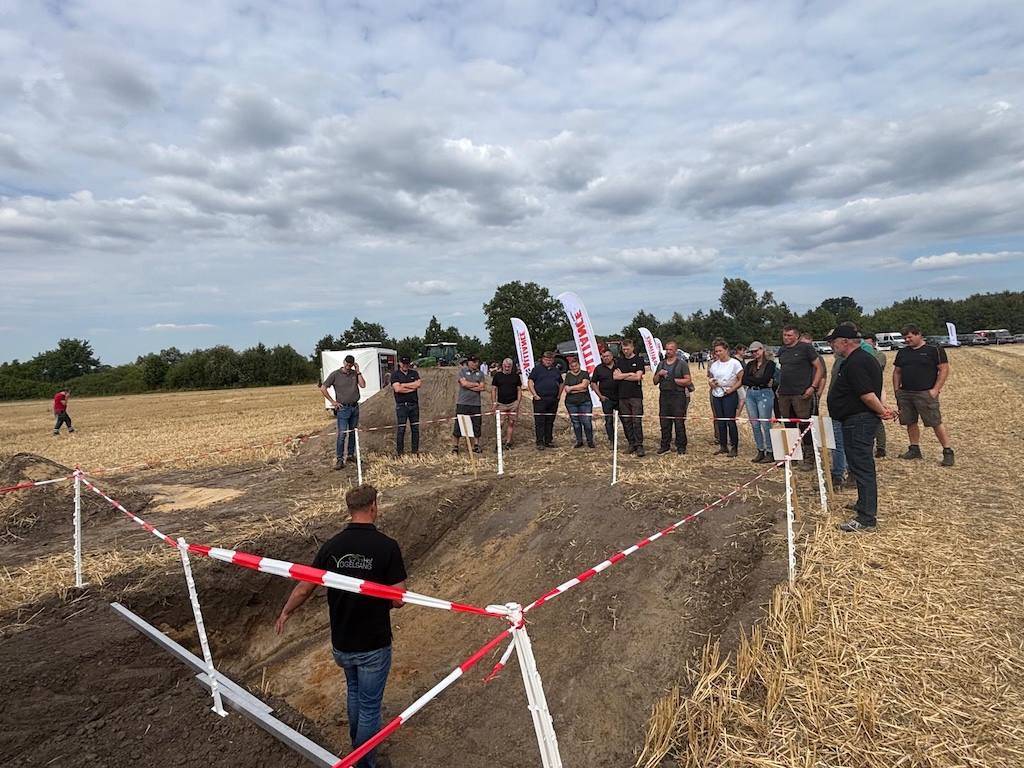
That was one of the messages from the first Alliance Field Day in eastern Germany, held at Bismark-Schernikau in the Altmark region on 26 August.
Supported by Bohnenkamp SE and AGRAVIS TECHNIK, the event used four practical demonstrations to show how tyre choice, inflation pressure, machine loading and operating conditions interact.
A key demonstration involved an agricultural sprayer fitted with Agriflex+ 354 VF tyres. Rather than treating inflation pressure as a fixed setting, Alliance specialists highlighted the need to consider axle load, operating speed and the particular operation being carried out.
Lowering pressure appropriately for field work allows the tyre to develop a longer footprint and spread the machine’s load over a greater area. VF technology can carry the same load at up to 40% lower pressure than a conventional radial tyre of the same size.
Looking below the surface
The implications for soil were demonstrated using an excavated profile. The exposed soil layers showed how machinery loads can be transferred below the visible wheel track.
This is important because surface appearance alone does not necessarily reveal the extent of compaction. Compacted layers below the surface can restrict root penetration and reduce the movement of air and water through the soil profile.
A correctly developed footprint can help distribute the load more evenly, although tyre pressure is only one part of the overall compaction equation. Machine weight, axle loading, the number of passes and soil conditions all influence the risk of structural damage.
A separate demonstration using Agriflex+ 372 tyres examined the relationship between inflation pressure and pulling force. Excessive pressure reduces the contact area, while insufficient pressure can distort the tread and reduce its ability to transfer power effectively.
Gerrit Vinkers, field service manager Europe at Alliance, says pressure should be matched to the job rather than treated as a single setting.
“Properly matched” pressure can allow more engine power to be converted into forward movement while reducing unnecessary wheel slip and associated fuel consumption.
Linking soil and efficiency
The final demonstration, using Agriflex+ 373 VF tyres, connected tyre pressure and footprint with wheel slip, fuel consumption and operating costs.
Reducing unnecessary slip is important from both an economic and soil-management perspective. Every additional wheel rotation that fails to produce forward movement consumes energy while potentially increasing the number of passes and the disturbance of the soil surface.
Farmer and agricultural content creator Stefan Vogelsang added a practical perspective, particularly for large-scale eastern German farms. He stressed the importance of adapting tyre pressure to individual operations and using no more ballast than is required to achieve efficient traction.
The field day demonstrated that tyre management is not simply a machinery setting. Correctly matching tyres, pressure, load and operating conditions can form part of a wider strategy for maintaining soil structure while achieving efficient field performance.
Related news: