
The Stephenson family farm about 1400ha of quite variable arable land at Withernsea, East Yorkshire just inland from the Yorkshire Coast. They are new ALS N-Sensor users this season having decided to take one on lease as a first move into variable rate farming.
Installed in January this year it has been used on both a spreader and Chafer sprayer, early applications being by the spreader and last application by the sprayer.
As part of Precision Decisions follow up service the company got back in touch with the Stephenson’s after harvest to find out how they had got along with this new piece of variable rate Nitrogen technology.
Virtually the first thing said was a comment from their combine driver David Stephenson “An unbelievably better harvest” followed by, from Keith Stephenson himself, “We are entirely happy with the performance of the sensor during this first season”
Whether on OSR or cereals the Stephensons’ felt that the N-Sensor had performed as promised. Within a short time, particularly by second application, they had passed through, “the sceptical stage” as Keith said, and could see from the maps, particularly the Biomass maps that the crops were being evened up across the fields. They used the N-Sensor in Absolute mode on OSR and both Target and N–Application mode on cereals depending on circumstances in the field.
Having attended the N-Sensor workshop at Lincoln Showground they found the learning and familiarisation process when first using the sensor a little daunting. A couple of early technical issues were dealt with by Precision Decisions in a timely and professional manner. Once up and running they settled into the mind-set of letting the N-Sensor “do its thing” even though at times this may have seemed a little counter intuitive based on past flat rate experience.
By the second application of Nitrogen the difference on the maps, Biomass and N-Application was quite evident. The first variable rate application had removed a huge amount of growth variation, and evened up the crop across different soil types within the same field. On the first application the sensor was up and down on its rates as the field was driven, but on the second application there was much less rate variation and a more consistent rate.
As the growing season progressed, not one of the best due to low levels of sunlight throughout May and June, both Keith and David could see just how even their crops were looking, this visual impression was confirmed by Biomass maps recorded by the N-Sensor.
Harvest time proved what they thought to be the case. Overall the harvest was by far the smoothest they had ever experienced. David (combine driver) was particularly impressed by the way that the combine drove. The much more consistent crops reduced RPM variations and header height movements markedly. Overall even-ness of the crops made the whole “harvest unbelievably better” from previous years. One field R36 has a particular area at ‘Wood Corner’ that when flat rate N applied, even with manual variation in previous years, has always suffered lodging. Since 2004, when David started driving the combine for Stephensons this part of field R36 has always suffered from lodging. This year there was no lodging here or anywhere else on the farm.
Overall, taking a poor growing season into account the Stephensons feel that the N-Sensor has contributed to at least 0.5 tonnes/ha additional yield on both OSR and cereals.
David went on to say that the N-Sensor “has definitely paid for itself during this first year of operation in increased yields and a much easier harvest”, he went on to say “it’s not necessarily about saving costs or reducing inputs, it’s about maximising the effective use of Nitrogen by putting it where it’s needed”
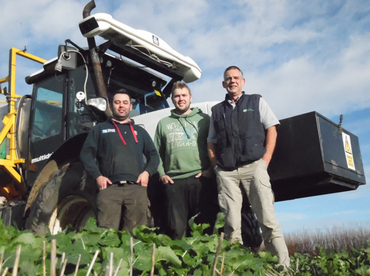
David Stephenson, Keith Stephenson and Chris Mason of Precision Decisions