

After facing high pressure from aphid-borne Barley yellow dwarf virus (BYDV) last season, cereal growers are advised to stay vigilant and protect vulnerable crops with effective chemistry this autumn.
BYDV is the most damaging virus of UK cereals, with severe infestations reducing winter wheat yields by up to 60%, and winter barley by 50%.
Bird cherry-oat and grain aphids are the two main vectors, and while not every aphid carries virus, AHDB monitoring shows autumn 2025 saw the highest proportion in recent years, with 35% of the bird cherry-oat aphids tested deemed viruliferous.
Targeted applications of pyrethroid-based insecticides are a key tool for managing aphids once thresholds are met, yet as Sumitomo Chemical Commercial Agro Manager for UK & Ireland, Ruth Stanley, explains, not all pyrethroids are the same, which impacts how they perform on-farm.
“Generally, most pyrethroids have a similar molecular structure, apart from esfenvalerate, which is chemically different.”
This gives esfenvalerate (as in Sumi-Alpha®) several distinct advantages over other pyrethroids; namely longer persistency, superior rainfastness, better repellency, higher activity at lower loading of active ingredient, and a kinder environmental profile for beneficials, including ladybirds, ground beetles, lacewings and predatory bugs, she says.
“It’s a very targeted product that ensures the right pest is treated effectively.”
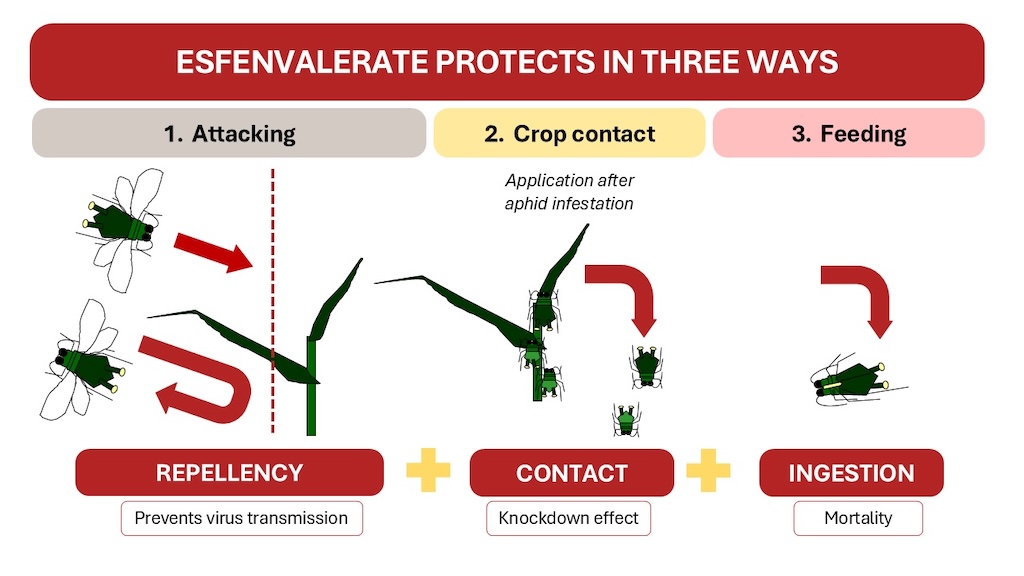
Strong repellency is particularly important for protecting crops, especially as it only takes about two seconds for an aphid to land on a plant, insert its feeding probe into a leaf, and potentially infect the plant with virus, Mrs Stanley says.
“Esfenvalerate works in three ways; knockdown, ingestion and repellency. By deterring pests going towards the plant in the first place, they don’t have to come into contact with the active during application or ingest it.”
Esfenvalerate is also more persistent on the plant than other actives, even in warmer conditions, which are becoming increasingly common in autumn, adds Aliona Jones, new Technical Demand Creator for Sumitomo Chemical in the UK & Ireland.
Laboratory trials comparing different pyrethroids exposed to high UV levels that mimicked long, hot days clearly showed esfenvalerate to last significantly longer than other actives.
“At the highest dose rate for autumn use (165 ml/ha), in some conditions, it can last up to six weeks,” she says. “This can potentially allow for savings to be made compared with having to treat crops more frequently with a different pyrethroid.”
This persistency comes despite needing a lower amount of active ingredient per hectare than other pyrethroids at higher rates, she notes.
“It’s a very low amount of active that needs to be used to form an effective dose, which is something that’s becoming increasingly important across the industry.”
Related news: