
An early recording of GB planting intentions for the 2020 harvest suggests a sharp fall in winter crops, largely because of the extremely wet weather throughout the autumn planting window.
An anticipated 13% fall in UK winter wheat planting but considerable (358%) rise in spring wheat would result in the lowest wheat area since 2013, a year which also followed a very wet winter. The intended winter barley area is 12% down, partly from rain interruptions but also a lower planned area.
Oilseed rape intentions are for a lower planted area (-23%). This includes a considerable amount of crop which might not survive through to harvest, partly because of rain and also CSFB damage.These problems combined has meant that much of the planted crop was slow developing and may suffer further losses.
Meanwhile, spring barley, oats (largely spring) and pulses areas are anticipated to rise sharply in 2020, by 28%, 10% and 24% respectively.
Winter wheat, winter barley and OSR area is falling sharply for the 2020 harvest.
Spring crops; barley, oats, pulses and other cereals and break crops are seen rising, along with a rise in fallow arable land.
Provisional results from the survey have been extrapolated onto the data from Defra’s provisional 2019 UK June Survey to produce forecasted crop areas for the 2020 harvest. Autumn drilling conditions have been awful in many parts of the UK with excessive rain for most. This meant far less winter drilling has taken place so far than usual.
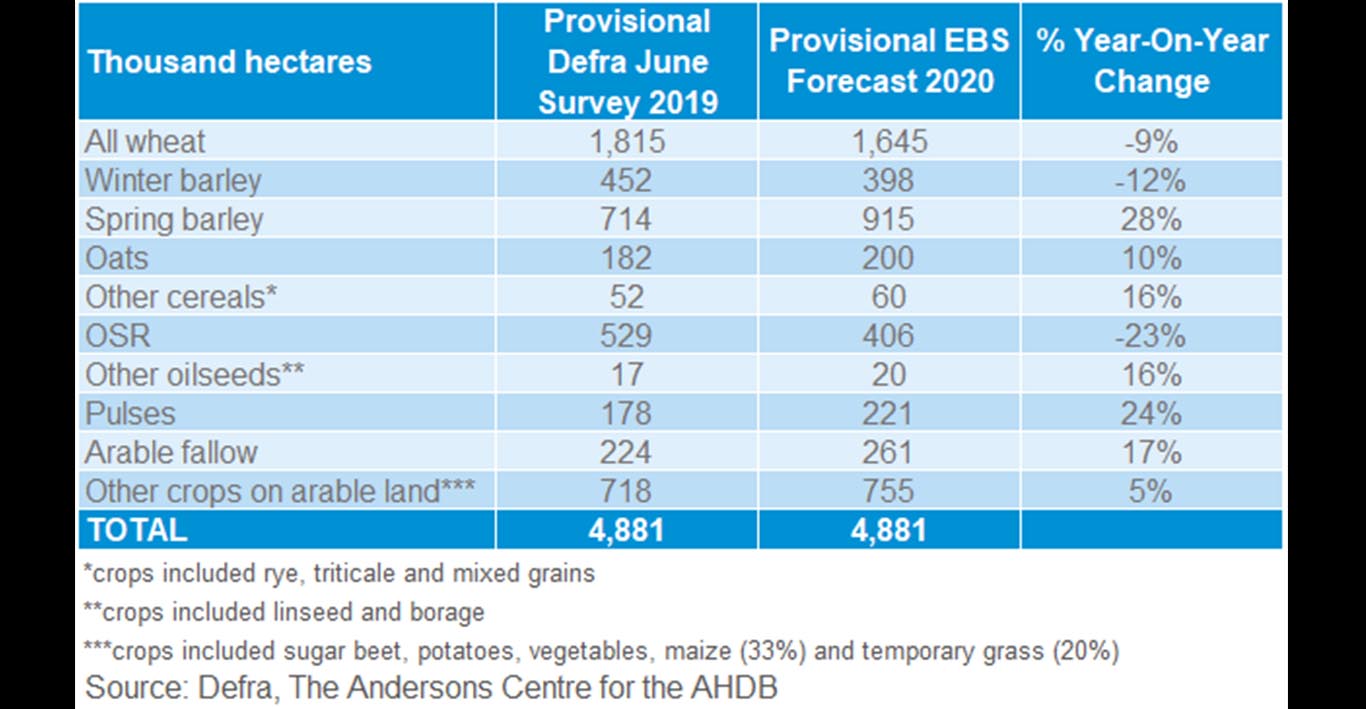
The wheat area is forecast to fall by 9% which, if correct, would result in 1,645Kha for harvest 2020, this would be the lowest wheat area since 2013, another year that experienced a winter drilling window. The spring wheat proportion within total wheat is seen rising a considerable 358%. It is thought that potentially half the UK winter wheat crop is still not planted though, so the decline could end up larger than the survey currently suggests.
The winter barley area is expected to fall by 12% to about 398Kha, although still higher than 2018. Oilseed rape is currently experiencing a 23% reduction to about 406Kha. This would be the smallest area drilled since 2002.
The area of spring crops are expected to increase in 2020 and could further rise depending on the next couple of months. Spring barley is anticipated to rise by 28% to 915Kha, a level not seen since 1988, when over a million hectares was cropped.
The survey suggests that the pulse area may rise by nearly a quarter to 221Kha, almost to levels seen in 2016. This is likely led by spring pulses but it is also noted that winter beans can generally be planted quite late in the season. Unsurprisingly, the fallow area is also thought to be rising (17%).
Other arable crops are all seen rising for 2020. This includes other combinable cereals up 16% (rye, triticale and mixed grains), other oilseeds also up 16% (linseed and borage) and other non-combinable crops on arable land (including roots, vegetables, and a proportion of maize and temporary grass crops) up 5%.
This survey is focused on the arable farm rotation rather than all arable land, which would include grass and forage rotations. For this reason, an estimate of the total amounts of these crops are used to include in the “other crops on arable land” figure. Crops of smaller area have a lesser area coverage in the survey, so these results are subject to greater uncertainty.
There are more planting intentions in this survey than usual due to the delays in winter drilling. Provisos therefore exist in whether this pattern will actually happen.
It assumes the weather returns to ‘normal’ levels of winter rainfall from now on and sufficient spring seed is sourced for the plans to be achieved. Also of note is that most growers will still, where possible drill their purchased seed as it is generally not possible to return it now, so late winter drilling may restart when conditions allow. These variables mean the actual harvested crop may still turn out to be different to what respondents reported in the survey.
Due to these reasons the Early Bird Survey will be rerun in the New Year to ensure it reflects the latest intentions of growers as the winter progresses and weather conditions change.
The survey carries a track record of very accurate figures. Nonetheless, the survey only represents a snapshot at a given point in time and therefore, should be interpreted carefully, especially this year with so much still to play for. Look out for the updated survey in the New Year.
The survey is based on measuring cropping change from the harvest just completed to the current growing season and plans for spring drilling. Rotational area surveyed is selected as those with no net change to their arable area, or where there is change, it can be reconciled within the rotation. In other words, because the survey measures the percentage change of each crop, the total crop area has to remain unchanged overall. Using the provisional results from DEFRA’s UK June Survey, it is then possible to predict crop areas for harvest 2020.