
The first spell of warm weather doesn’t mean it is time to drill maize. In recent years it has paid to hold back and wait until conditions are correct. Tim Richmond, Maize Product Manager at LG Seeds is responsible for the marketing, new product development, import and delivery of wholesale maize seed in the UK and Ireland. He has worked in the agricultural industry for over 25 years and gives his advice about early drilling.
The advice is often to drill early to increase yields by giving a longer growing season. This has largely been overtaken by the development of early maturing varieties which yield well in a shorter season and will mature over 14 days earlier than the latest varieties.
Early drilling is higher risk:
In cold soils, rate of germination is reduced
In wet soils, seed can rot
Higher seed rate commonly advised to compensate for seed loss, pushing up costs
If you are going to lose seeds, you should not be sowing.
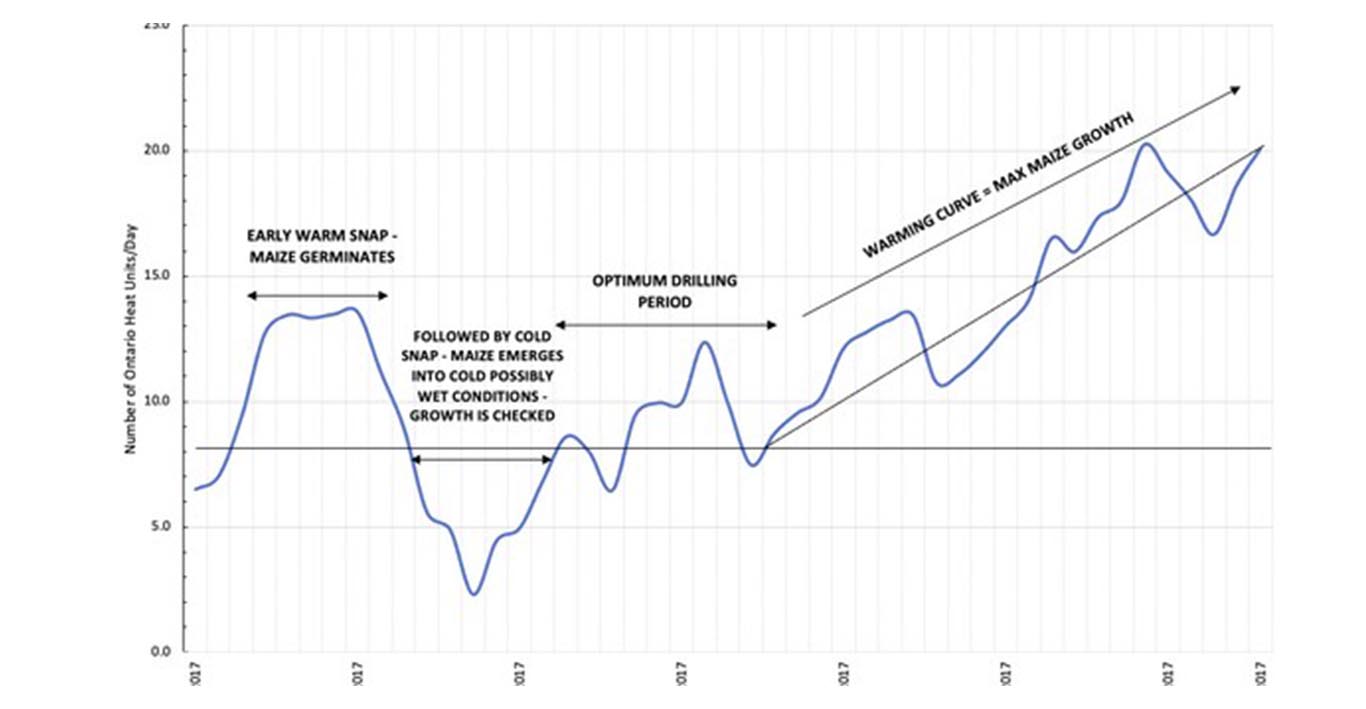
Look at the facts based on our seven sites around the country. The graph shows the mean temperatures across all seven sites for the last three years and highlights the possible issues for maize drilling.
In the last three years there has been an early peak in temperatures around 20-24th April
This has been followed by a substantial temperature drop to below 8°C for 2-3 weeks.
Temperatures did not consistently exceed 10°C until 4-13th May but then rose consistently.
In each of the last three years:
Seed drilled in early April would have struggled to get away. It would either be chilled in dry soils or would rot in wet ground.
Later drilled seed would have germinated much quicker and resulted in a stronger early crop Sowing should not have started before the end of April.
Targets for successful establishment:
Soil at 8-10°C at the target drilling depth for at least a week before drilling. Clearly the deeper you drill, the later this can be.
Create a fine, firm seedbed with no clods and minimise compaction to ensure good contact between the seed and the soil
Seed should be drilled at uniform spacing to promote even germination and growth followed by consistent canopy closure.
Use biological seed dressings including plant polymers such as Starcover to encourage more rapid and enhanced root growth.