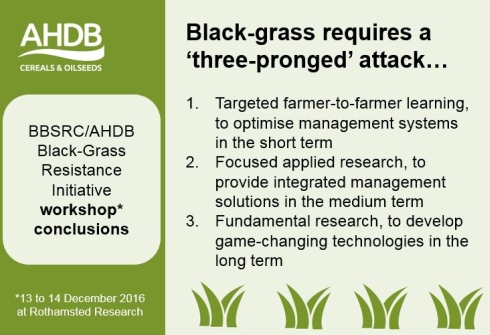

Black-grass requires a three-pronged attack to promote and develop sustainable management solutions, according to the main findings arising from an AHDB-funded workshop.
Organised by the BBSRC/AHDB Black-Grass Resistance Initiative (BGRI), the workshop bought farmers, industry and researchers together to help concentrate the UK’s black-grass management efforts.
Three areas of focus were identified at the workshop: Targeted farmer-to-farmer learning, to optimise management systems in the short term; focused applied research, to provide integrated management solutions in the medium term; and fundamental research, to develop game-changing technologies in the long term.
Dr Paul Gosling, who manages weed research at AHDB, said: “The headline grabbing topic of black-grass has fuelled multiple of avenues of research, conducted within the UK and overseas.
“But this research effort has lacked coordination, meaning progress on managing black-grass has often been too slow and too erratic.
“The BGRI sought to address this with its multidisciplinary approach, by bringing people together with significant experience of tackling black-grass, from the field to the laboratory, to talk freely and extend the BGRI collaboration ethos right across the industry.”
In the short term, it was concluded that ‘persistent messaging’ of evidence-based recommendations is required to give growers the confidence to use current management tools.
More effective seed bank and long-term population management was seen as a particular priority, which could be achieved through the increased adoption of weed monitoring and mapping techniques, in conjunction with a greater use of resistance diagnostics and testing. It was felt that such information could be used to target late drilling, variable seed rates and spring cropping approaches in the worst affected parts of the farm.
Farmer-to-farmer learning was considered as being particularly valuable to help promote new ways of working, especially on heavy land (where management is particularly challenging) and in strategically important areas to reduce further black-grass spread.
In the long term, it was concluded that ‘game-changing’ technologies are needed to reverse the spread of resistant black-grass in the UK.
Dr Paul Neve, who is a principal investigator for BGRI at Rothamsted Research, said: “There are some really exciting, yet high-risk, high-reward, developments in the pipeline.
“Many of these capture the value in emerging areas of science, such as weed genomics, diagnostics, remote sensing, and big data and modelling applications.
“These long-term solutions may be years away, and, until then, it is all about the hard graft associated with combining multiple approaches to keep a lid on the problem.”
For the latest information on black-grass, visit www.cereals.ahdb.org.uk/blackgrass, www.bgri.info and www.rothamsted.ac.uk/weed-ecology-and-evolution.