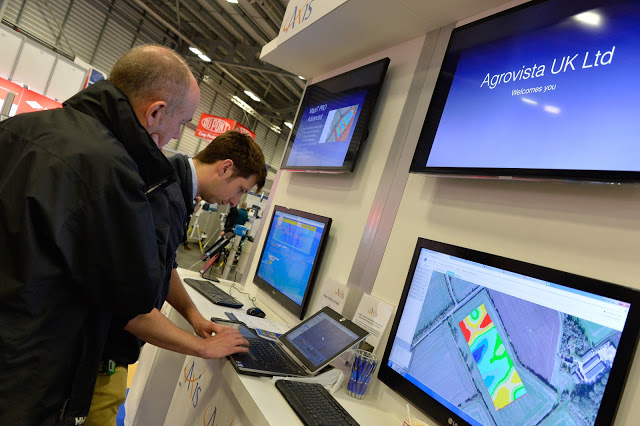

Some of the most advanced agronomy tools available to UK farmers was on display at Agrovista’s stand at this year’s CropTec, where visitors were able see how new technologies could benefit their businesses.
Use your own drone
Latest drone developments, including software that allows growers to use their own drones to map fields was on show. Agrovista has compared professional fixed-wing drones with popular “hobby” multi-rotor drones to see if the basic camera gear on the latter can be used effectively to create weed and biomass maps.
“Results have been very encouraging, allowing Agrovista to develop its Axis MapIT Pro software to handle the processed drone data,” says head of precision technology Lewis McKerrow.
“This will enable growers to use the information for applications such as variable rate nitrogen, and even patch spraying glyphosate with high resolution accuracy.”
Further developments include yield prediction models that can be used a few months before harvest.
MapIT Pro – simplifying agronomy management
MapIt Pro is part of Axis, Agrovista’s cloud-based agronomy management system, that helps growers cope with the vast amounts of digital information created on their farms as the adoption of decision-support and precision-farming systems grows.
MapIT Pro enables users to control and map data simply and quickly, allowing the many pieces of the precision farming jigsaw to fall into place.
One example is variable rate drilling. “The software crunches crop biomass data scanned several times over a season to create the initial field zones,” says Mr McKerrow.
“Other know field variables, such as slug or rabbit damage, frost heave and/or soil type can be overlaid to create the final zone map. From this, a zoned variable seed map can be drawn up at the touch of a button.”
Saving costs with companion plants
Companion plants in oilseed rape have been shown to provide a number of advantages, including improved establishment, nutrient capture, better weed and pest suppression and ultimately increased yields.
Berseem clover as a companion plant can help with all these, but its major impact is on improving establishment and rooting of OSR, boosting rape root size typically by about 20%.
Visitors heard how Agrovista is broadening the project to several sites to see if berseem clover can really replace steel when it comes to cultivations.
“At the heavy-land Stoughton site last year, oilseed rape was either direct drilled, or drilled behind the leg of a Great Plains 00 planter, both with and without the addition of berseem clover,” says technical manager Chris Martin.
“The oilseed rape behind the leg yielded 0.5t/ha more than rape direct drilled alone. However, where the direct drilled crop included berseem clover, its yield matched that of drilling behind the leg.”
The difference in fuel consumption between the two establishment techniques will be accurately measured at this season’s development sites.