
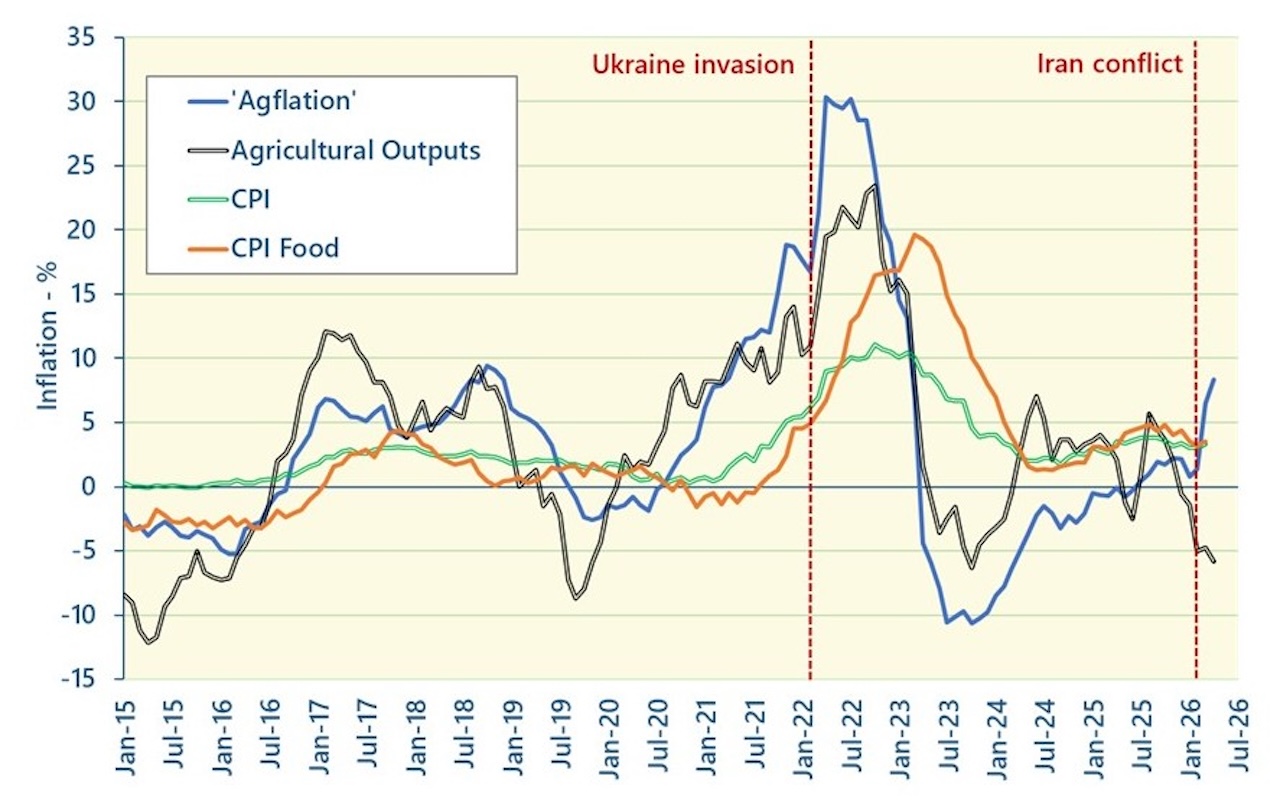
UK arable farmers are facing renewed cost pressure in 2026 as agricultural input inflation — often referred to as “Agflation” — climbs sharply while farm-gate returns weaken, tightening margins across combinable crop systems.
Latest estimates from Andersons Farm Business Consultants put input inflation at 8.4% year-on-year in April 2026. This is significantly above general inflation (CPI at 3.3%) and well ahead of the Bank of England’s 2% target. In contrast, average agricultural output prices have fallen by 5.8% over the same period, creating a widening cost–price gap for growers.
For arable businesses, the most immediate pressure point is fertiliser. Ongoing geopolitical instability in the Middle East and concerns over shipping through the Strait of Hormuz — a key global energy and fertiliser corridor — have supported higher input prices. Around 30% of global urea trade moves through this route, with UK urea prices now estimated at £650–700 per tonne. Ammonium nitrate is also rising in line with natural gas markets.
This comes at a critical time in the arable calendar, with fertiliser demand building ahead of spring applications and planning for the 2026/27 cropping year. Higher nitrogen costs are likely to influence application rates, crop choice and overall input strategy, particularly where margins are already under pressure.
While wheat prices have improved by around 12% year-on-year, supported by global supply concerns linked to the Middle East conflict, this uplift is only partial compensation for higher input costs. Dry weather conditions in parts of the UK are also raising concerns over yield potential, adding further uncertainty to forward crop budgets.
Fuel and energy costs are also expected to remain firm, with knock-on effects across cultivation, drilling, spraying and grain drying operations. Machinery running costs, including parts and servicing, are similarly exposed to ongoing inflationary pressure.
What this means for the arable sector?
For UK arable farmers, the current environment is likely to accelerate a shift already underway in strategy. Cost pressure typically reinforces interest in:
- Reduced cultivation passes and lower diesel-use systems
- Direct drilling and minimum tillage approaches
- Improved nutrient-use efficiency and precision application
- Greater focus on soil organic matter and water retention to stabilise yield risk
In practice, this means soil management is becoming not just an agronomic priority, but a core cost-control tool.
Contractors and machinery suppliers are also likely to see changing demand patterns. Investment decisions may tilt towards versatile, lower-horsepower, multi-pass reduction systems rather than high-capital replacement fleets, while precision and guidance technologies that reduce inputs could see stronger uptake.
Looking ahead, the key question for arable businesses is no longer only yield potential — but how efficiently that yield can be produced under structurally higher input costs and more volatile output pricing.
Related news: