
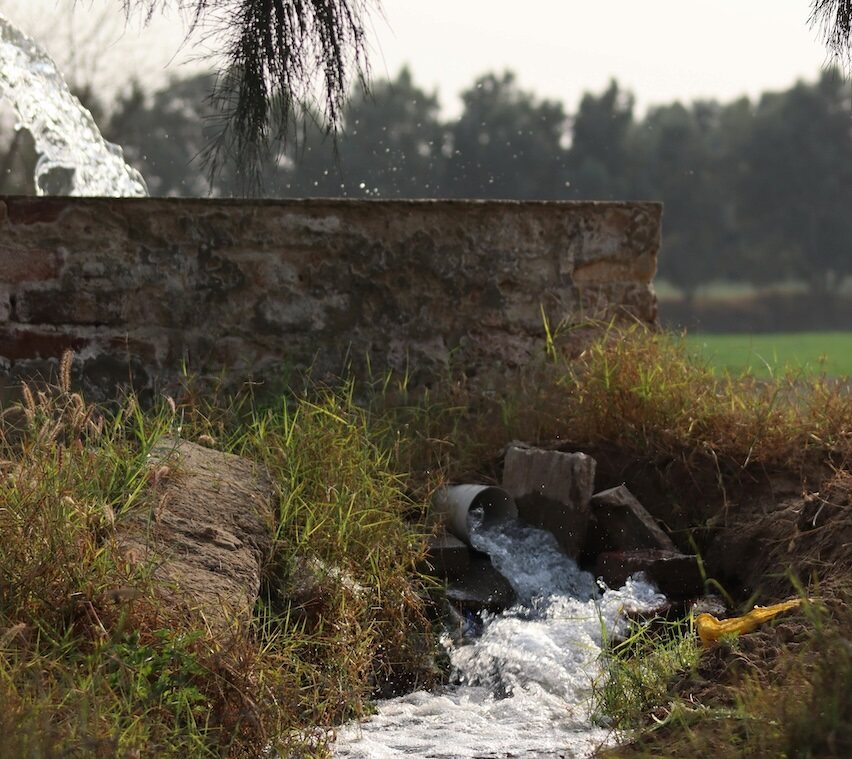
The UK Agri-Tech Centre has worked with agri-tech businesses to prove and trial their technology to ensure it meets the challenges of water quality and management on-farm and across the agri-industry.
The production and protection of safe water is directly linked to the healthiness of our soil, and therefore our energy and food consumption.
The UK Agri-Tech Centre has worked with some innovative partners, supporting projects that do exactly this.
Here are three projects that help to protect and maintain safe water:
- STREAMS (Space Tech for River Environments & Agricultural Monitoring Sensors)
Diffuse nutrient pollution is one of the biggest pressures on Welsh waterways, with iconic rivers like the Teifi repeatedly failing phosphate standards.
These pressures affect the longterm health of our landscapes, including biodiversity, land use and the resilience of rural communities.
Monitoring water quality in real time can accelerate mitigation efforts, but traditional sensors are often too expensiveand many rural areas lack the reliable connectivity needed for automated data transfer.
As a result, we frequently rely on manual water sampling, which can miss shortterm pollution spikes and delay rapid intervention when it’s most needed.
The Innovate UKfunded STREAMS project aims to overcome these challenges, by making waterquality monitoring more affordable, reliable and continuous, even in the most remote areas of rural Wales.
Project lead, Lacuna Space, is working with Aberystwyth University and the UK Agri-Tech Centre to combine three core innovations:
- A lowcost multiparameter sensor measuring nitrates, phosphates, dissolved oxygen, pH and other indicators of river health
- Lacuna’s LoneWhisper® satellite-IoT Technology, enabling sensors to transmit data without the need for network connectivity
- A bilingual Welsh–English dashboard, codesigned with end users, providing clear, realtime insights for farmers, land managers, community groups and environmental professionals
Working alongside local authorities, environmental regulators, regional communities and land users, there will be bilingual workshops and engagement events to co-develop tools, test sensor performance, refine the dashboard and ensure STREAMS delivers genuine value on the ground.
Although STREAMS is rooted in Wales, the challenges it addresses are global: many water challenges are due to poor connectivity, making monitoring impossible.
But Lacuna’s connectivity is making monitoring possible anywhere in the world and the team is already in discussions with partners as far away as Brazil, exploring how STREAMS technologies could support freshwater quality improvement overseas.
By proving the model here first, Wales is positioning itself as a leader in satelliteenabled environmental monitoring and helping shape cleaner, healthier rivers for communities worldwide.
Interested in getting involved? Watch this space for news on upcoming engagement events across the Ceredigion region.
- NURSE (Nutrient Utilisation and Recovery through Supercritical Extraction)
The NURSE project is led by collaborators including Kairos Carbon Limited (lead), Cranfield University, Royal Agricultural University and the UK Agri-Tech Centre and is part of Defra’s Farming Innovation Programme, delivered in partnership with Innovate UK.
It aims to develop an advanced hydrothermal technology to process livestock wastes — to recover the valuable nutrients they contain — producing carbon-negative, non-leaching fertiliser, while separating the carbon for permanent sequestration.
The UK produces approximately 140 million tonnes of livestock waste annually, most of which is spread on farmland.
The work of the project will help to reduce emissions by stripping out any carbon before fertiliser is applied to the land.
Less than 50% of applied nutrients, such as phosphorus, are taken up by crops when livestock waste is spread on land.
Meanwhile, farmers’ fertiliser costs are increasing while fertiliser resources, such as phosphorus, are being depleted.
By formulating non-leaching fertiliser, which enables more of the nutrients to actually be absorbed by plants, the project aims to keep farmers’ costs down and reduce waste of resources.
It is vital that farmers are given new tools to recover and reuse valuable nutrients, whilst also reducing their environmental impacts.
The technology directly benefits farmers and their impacts through recovering critical materials from livestock waste in condensed form for targeted use as low-leaching, sustainable fertiliser, reducing costs and improving yields.
It also allows for better management and processing of waste, the destruction of organic pollutants and the extraction of carbon for capture and storage, all while being energy-neutral.
Kairos aims to reduce emissions from UK agriculture as well as prevent pollutants and nutrients from entering water sources.
It also aims to prevent air pollution from livestock waste and many other sources of agricultural pollution.
- NTPlus2
The NTPlus and NTPlus2 projects are led by Agua DB, an expert in ion exchange technology in collaboration with the UK Agri-Tech Centre.
The aim is to develop a modular, integrated solution for nutrient recovery from wastewater and address technical barriers to commercialisation.
The cutting-edge NTPlus technology generates high nitrate irrigation water, low nitrate drinking water and transforms potash into sulphate of potash, boosting crop resilience to drought, stress, disease and pests.
Agua DB’s approach addresses the ‘Nitrate Timebomb’ by recovering nitrates that would otherwise leach into aquifers, turning them into a valuable resource for farmers.
This process not only improves water quality but also promotes efficient irrigation practices and greenhouse growing, making agriculture more sustainable and resilient to climate change.
NTPlus2 extends the process to recover nutrients, including phosphates, at wastewater treatment plant where the novel use of plasma will be trialled as a method of disrupting persistent organics, including herbicides and pesticides, as well as generating additional green nitrate in the product.
Its overall aim is to develop the process for optimised recovery of nitrate and phosphate from WWTP, improving sludge properties and producing a liquid fertiliser which will be demonstrated and validated for use in crop trials, supporting commercial adoption and integration into the liquid fertiliser supply-chain.
Rebecca Lewis, Head of Bid Development at the UK Agri-Tech Centre, said: “These projects show just some of the range of exciting innovations that are being developed to help deliver more resilient and healthy water systems.
“Technology can play a key role in securing a sustainable water resource for farms, ecosystems and communities.”
For more information about the work the UK Agri-Tech Centre does, and the projects and agri-tech businesses it has supported, visit www.ukagritechcentre.com
To find out more about the ways in which water innovation can be improved, visit Innovate UK’s Cross-Sector Water Innovation Network at https://iuk-business-connect.org.uk/programme/cross-sector-water-innovation-network/
Related news: