
- UK organic fertiliser producer, SoilWorx, announces three new products to protect yields and improve long-term soil health.
- The company has invested significantly in its plant and independent research to develop new products and meet demand.
- SoilWorx closed-loop production process opens up new opportunities for farmers and growers.
As 2026 crop plans are refined and finalised, organic fertiliser producer SoilWorx has announced it is expanding outside its traditional Irish heartland. It is now set to offer mainland UK farmers new ways to improve soil health whilst maintaining yields.
The business promises to combine proven performance, consistency and large-scale, dependable supply with the agility and responsiveness of its family firm. SoilWorx says it will continue to support organic farmers whilst opening new opportunities for farmers considering regenerative and hybrid approaches that blends organic and chemical inputs.
“Best of both worlds”
Whilst SoilWorx has traditionally served organic farmers with fully certified, products, it believes real benefits also exist for farmers incorporating organic nutrition into their crop plans.
Three new agricultural product ranges are launching, with Organo Mineral Fertilisers (OMFs) at their core – products that blend instant-release mineral nutrients with the phased release of organic amendments.
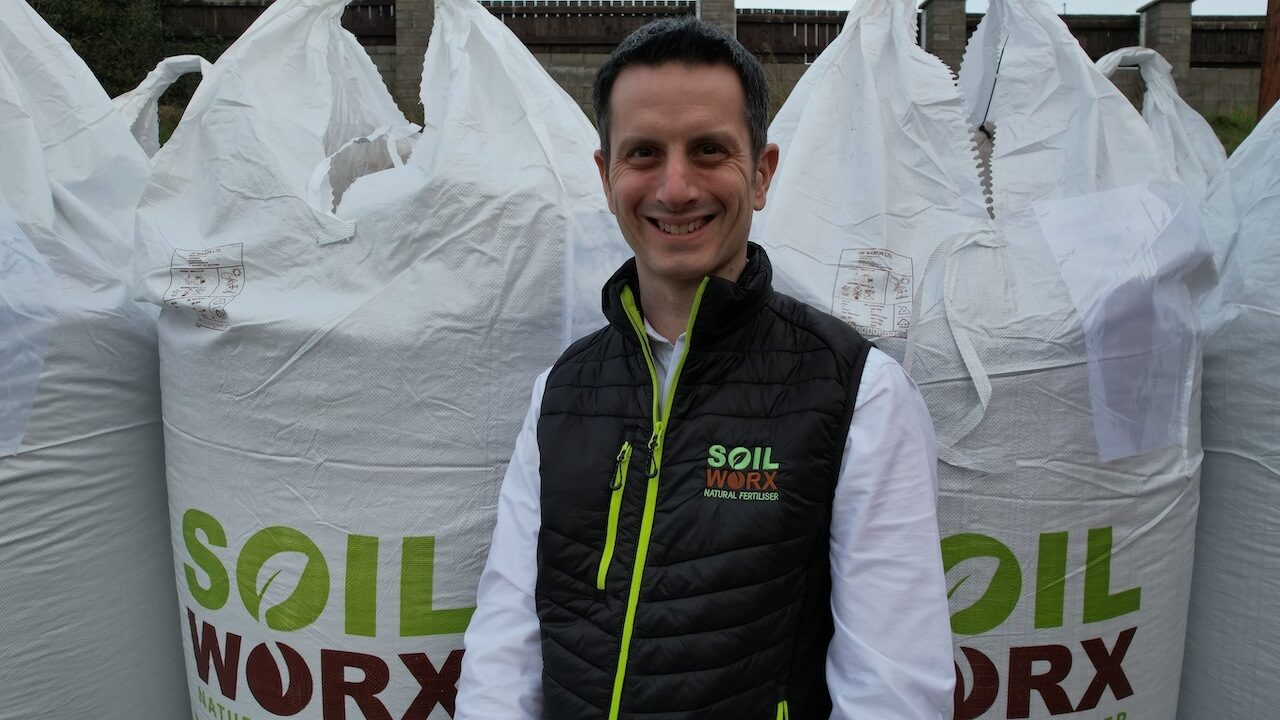
“It’s that best of both worlds,” Dr. Paul O’Hora, SoilWorx Sales Director explains. “An instant hit of mineral fertiliser that’s readily available to the crop, followed by the phased release of nutrients from the organic matter. You get that nice balanced approach.”
SoilWorx’s core product is a 4-2-3 NPK, but listening to farmer feedback – something Paul believes SoilWorx is uniquely positioned to do – has driven development of higher nitrogen options. These include an 8-2-2 formulation which is now available and a range of OMF products such as 12-1-1 and 10-4-4 in advanced stages of development.
Quality, consistency and dependable supply
The hybrid approach offers multiple benefits: maintaining yields, building soil health over time and potentially reducing synthetic inputs whilst organic matter improves nutrient availability. Together with SoilWorx’s circular manufacturing process, it can also enable access to sustainability schemes and carbon payment programmes and open up new markets to customers further along the food chain, seeking to reduce their Scope 3 emissions.
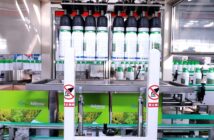
“A real problem that farmers have faced in the past is product consistency and the reliability of supply,” says Paul. “That’s not an issue with SoilWorx. We’ve invested heavily in our plant and our fully automated production line is capable of producing 500 tonnes of pellets every week, to exactly the same specification. Our process of composting, heating and sterilising delivers consistent product quality whilst eliminating pathogens too.”
After milling, the material is pelletised to approximately 5mm diameter before bagging. This means the pellets are designed for practical use – consistently smaller, denser and more compact than many competitors’ products that can disintegrate into dust when spread. SoilWorx pellets work in standard spreading equipment and require no investment in new machinery.
Investing in research
With a track record in both The Republic of Ireland and Northern Ireland, SoilWorx’s confidence in their products rests on farmer satisfaction levels and has been further boosted by early indicators from independently verified field trials data. SoilWorx is now working with Rothamsted Research on long-term soil health studies and participating in a soil health barometer project examining DNA of soil microorganisms.
Trials with Agrii across the UK in 2026 will explore hybrid approaches and OMF applications across multiple soil types. Early results from other OMF trials have shown the products outperforming mineral and other systems in 2024’s wet conditions, with nutrients retained rather than leached out.
“We’re not looking for additional yield boost,” Paul clarifies. “We’re looking to show our products maintain yields whilst building soil health. This provides added bonuses – for example reduced micronutrient inputs, or less synthetic fertiliser required.”
The right time for hybrid approaches
SoilWorx believes multiple factors make 2026 the ideal time to consider hybrid approaches.
Fertiliser prices are climbing again, environmental pressures continue to mount and climate change impacts are increasingly visible on farm. Policy frameworks are beginning to reward more sustainable farming practices through schemes like SFI and various carbon payment systems.
With SoilWorx’s products having a lower carbon footprint compared to traditional fertiliser, there’s a straightforward route to reducing Scope 3 emissions. Looking further ahead, the Carbon Border Adjustment Mechanism (CBAM) coming to the EU in 2026 (and likely to impact the UK in 2027) will add carbon taxes to imported fertilisers, potentially driving synthetic fertiliser prices higher and making hybrid approaches increasingly cost-competitive.
Related news: