
Farmers should apply for the recently announced Farming Equipment and Technology Fund (FETF) and Sustainable Farming Incentive (SFI) grants as soon as applications open to maximise the likelihood of a successful claim, agricultural machinery manufacturer Claydon advises.
“FETF26 grants will still provide a substantial contribution towards the cost of new qualifying machinery, even though the levels are unchanged from last year. Applications open on 17 March, and close on 28 April, so farmers should give it their immediate attention,” says David Furber, Claydon’s UK Sales Manager.
“The first round of the SFI26 will open in June for small farms with up to 50ha of agricultural land and those without an existing Rural Payments Agency (RPA) administered Environmental Land Management (ELM) revenue agreement. The second round of SFI will open in September 2026 for all farms, although no fixed end date has been set as this will depend on how many apply. This is good news for larger farms which do not currently have an SFI scheme in place and are not now receiving BPS payments, although the maximum amount per agreement will be capped at £100,000.”
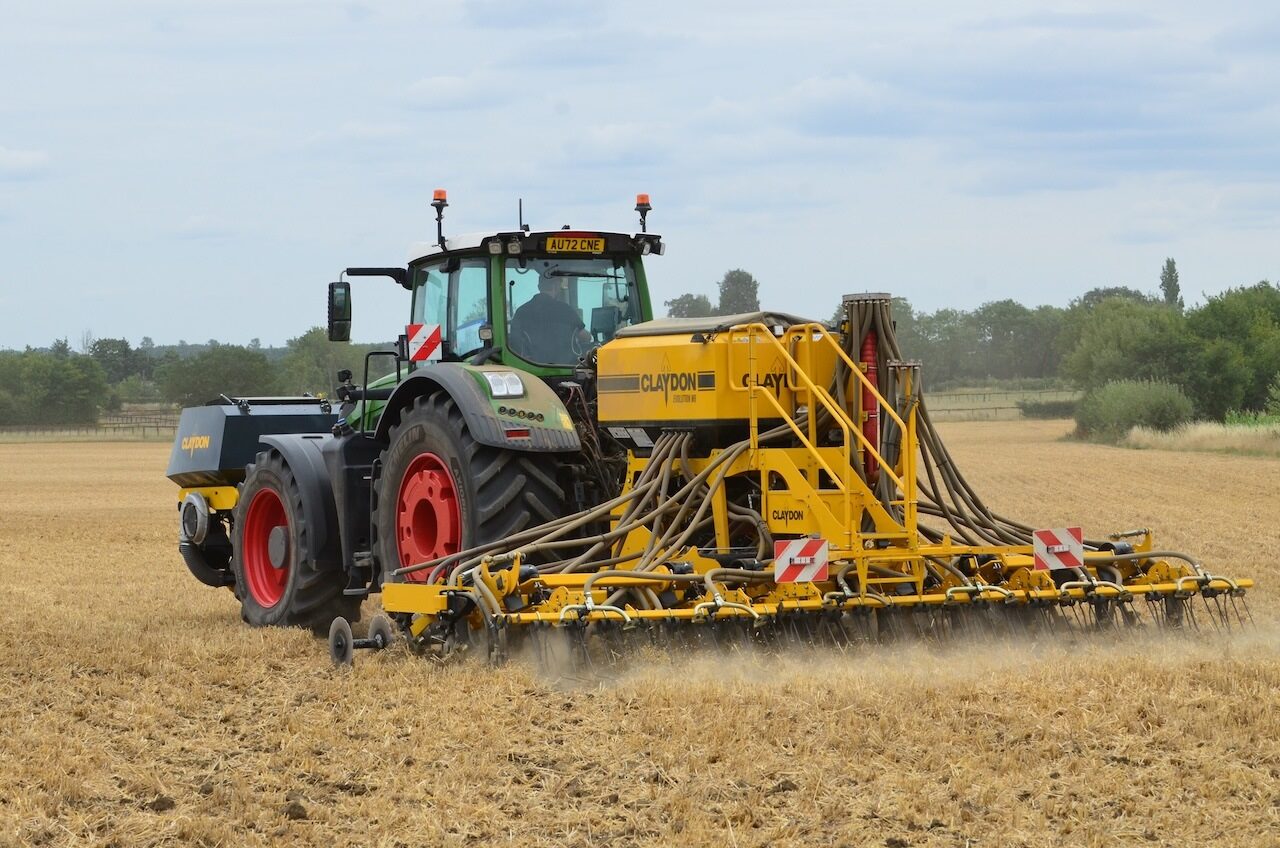
Claydon machinery which qualifies for a Farming Equipment and Technology Fund grant includes the company’s Evolution mounted direct drills from 3m to 6m wide and Hybrid trailed direct drills from 3m to 8m wide. These qualify for a grant (FETF44 – Direct Drill) of up to 50% of the on-farm price, with a maximum value of £15,067. Claydon’s twin-hopper NutriSeeder is also eligible (FETF207 – Air Drill for establishing cover crops) for a grant which covers 50% of the on-farm price, up to a maximum of £1,575. Claydon Straw Harrows from 6m to 15m wide are eligible for a 40% grant, up to a maximum of £6,720 (FETF208 – Tractor Mounted Stubble Rake).
With over twenty years’ experience Claydon is the European market leader in direct drilling technology with its Opti-Till® system. This holistic approachof crop establishment eliminates unnecessary cultivations, allowing consistent, high yielding crops to be established at approximately one-third the cost of plough-based methods and half that of min-till, providing maximum profitability whilst improving soil health. The availability of FETF grants further increases the attractiveness of this approach, which is why Claydon is advising farmers who are considering updating their machinery to do so without delay.
Farming Profitably Before Grants
“The most important management action in farming is to control the controllables,” David Furber adds. “Lacklustre grain prices are encouraging farming businesses to move away from traditional crop establishment methods which are slow and expensive. With machinery and labour accounting for up to 60% of fixed costs the need to adopt more efficient ways of working will accelerate, with direct drilling’s significant financial and ecological advantagesbecoming even more advantageous.
“Whilst the FETF and SFI grants are great to have, Claydon Opti-Till® makes it possible to farm profitably without them, allowing any additional income from this source to be regarded as a bonus. So if you wait for months until your grant application has been approved, then incur further delays before your new Claydon machinery arrives, you will miss out on months of financial, agronomic, soil and time-saving benefits.”
Opti-Till® has been used on the Claydon family’s arable farm in Suffolk since 2002 and the results get better every year.
Instead of the 150-180 litres of fuel/ha that was once used to establish crops using a plough-based approach, with Opti-Till® it now averages 12l/ha, including all stubble management and drilling. Overall fuel use last season was just 40 to 50 l/ha, including stubble management and drilling, spray and fertiliser application, inter-row hoeing with a 6m Claydon TerraBlade, harvesting and corn carting.
Tractor hours have fallen by 80%, and in three years the main drilling tractor, a 2022 Fendt 942 Vario, has only just passed 1200 hours, even though in 2025 it drilled the farm two and a half times with a 6m Claydon Evolution to sow catch, companion and main crops. Wear and tear, servicing costs and depreciation are significantly lower and at £3-£4/ha the cost of wearing metal is negligible.
The benefits have been reflected in the farm’s bottom line; excluding support payments, the business has made a profit every year since it began usingOpti-Till®. Given governments of all political persuasions have a habit of changing direction with little warning being financially independent of them is a good position to be in. Profits are largely reinvested in the farm, whether to keep machinery up to date or in longer-term projects such as field drainage, putting the business on a sound footing for the future.
The massive changes to the Basic Payment System in England reduced the Claydon farm’s annual income by approximately £60,000, forcing the business to consider the options. Having invested time and resources it identified over £94,000 in potential gains, equivalent to £370/ha, under the Sustainable Farming Incentive (SFI). Whole Farm Management Payments (WFMP) worth £5408 have been dropped from SFI26 so has fallen to £88,995.
“In the future it will be difficult for farming businesses to remain viable using traditional establishment methods because there will be more time pressure to do all the cultivations, produce cover crops and establish cash crops in the autumn,” says owner Jeff Claydon. “In the current environment the saying ‘If you don’t change anything, nothing changes’ is very appropriate because if you keep doing the same things that you’ve always done, you will keep getting the same results.
Related news: