
Heavy rain and high volumes of water can frequently lead to environmental and socio-political issues: from nitrate leaching and pesticides entering surface water and causing fish to die, through to landslides and desolation as a result of soil being washed away, erosion, loss of humus and yield depletion.
When large, heavy rain drops impact the soil with maximum force, the soil breaks up into its smallest components. This, combined with large volumes of water flowing across the surface, causes erosion to take over. On slopes the problem is even more critical. Surface ponding and soil erosion cause unnecessary costs with surface soil or pools of water accumulating in private gardens, or loss in value of arable fields as a result of humus erosion.
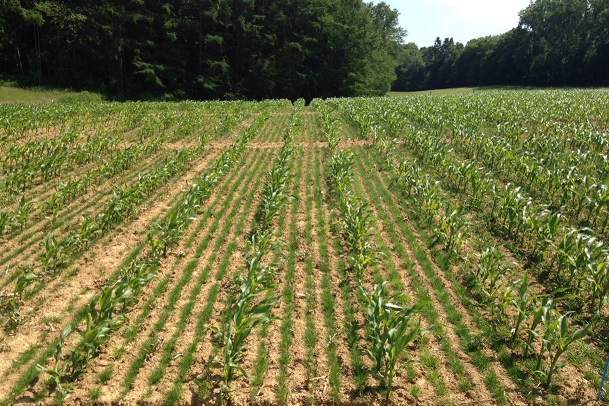
Pottinger advise that erosion can be reduced by using a companion crop and suggests its Aerosem mulch seed drill is ideal for planting, especially with maize.
In a series of tests performed by Pöttinger in cooperation with UCL university in Belgium, they report they have perfected the process for achieving the optimum ratio between the companion crop and primary crop seed rates for a perfect balance between reducing soil erosion and increasing yield.
The right application of the companion crop plays a decisive role: it is essential that the companion crop is drilled at the same time as the maize in a single pass. In addition, the companion crop must be placed using purpose-specific shares so that germination starts as soon as possible.
This process is necessary to ensure rapid development of the companion crop. Only then can erosion protection take effect. Broadcasting would leave the companion crop on the surface, delaying germination so that cover is not provided until later.
By the time the first phytosanitary measures are applied to the maize in its six to eight leaf stage, the companion crop has become well established and is in a position to withstand such measures. Pottinger say its rate of growth will be slowed down slightly, but it will not be destroyed. The companion crop loses height compared to the maize so that the maize plants can continue to develop unrestricted. Following the row integration of the maize plants, the companion crop is growing at its full rate again and the available light is sufficient to ensure that the companion crop covers and protects the soil.
The Pottinger Aerosem drill is fitted with up to ten individual seed elements for a row spacing of 37.5 cm or 75 cm. Application-specific fertilization is also built into the machine: using the standard metering system with a distributor head add-on, fertilizer can be applied between the seed rows. The technical features in detail
The seed hopper is divided into two segments: one for precision seed drilling (there are no individual tanks for each row) and one for fertilizer or the companion crop. Switching between normal drilling and precision drilling is performed by moving the partition between the two segments. A seed level sensor is fitted on both sides.
Pottinger recommends that if a companion crop is planted correctly it is a sustainable method that will provide clear economic advantages.