
More of the same is not an option for the Shelby family’s 380 ha mixed livestock and arable business at Benningholme Grange Farm to the northeast of Hull. Not least with the headache of difficult black-grass, the challenge of difficult ‘carr’ land and increasingly unpredictable seasons and markets.
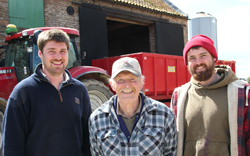
Instead, Guy Shelby, his father Chris and brother David have been working closely with their Agrii team to successfully drive fundamental arable change across their Crown Estate tenancy; a forward-thinking and enthusiastic commitment that has been recognised nationally with the Arable Farmer of the Year title in the 2016 Farmers Weekly Awards.
Amongst other developments at Benningholme Grange, precision agronomy is ensuring increasingly well-targeted and cost-effective input use; strip tillage is transforming establishment and dramatically reducing fixed costs; greater reliance on spring cropping and better all-round variety choice is adding invaluable agronomic and marketing flexibility; and introducing fodder catch crops and grass into the rotation is aiding the battle against black-grass.
“Mosf of the land lies at or below sea level; its glacial clay includes sandy, loamy and peaty areas; every field has wet holes that can be almost impossible to crop; and none of the ‘carr’ can be drilled late in the autumn or grow second wheat.
“Add in difficult black-grass in many places and our challenges mean it simply wouldn’t be sustainable to stick with blanket P&K applications and seed rates, expensive and inflexible plough and power harrow establishment, ‘all from the can’ crop protection or a firmly feed-quality winter cereal-based rotation. Especially so, with such uncertainty over commodity prices, not to mention agricultural support.”
Working with Agrii agronomist, Billy Hosdell, Guy had the whole farm SoilQuest conductivity scanned, sampled and mapped in the autumn of 2012. Unimpressed with the grid-based sampling approach of others, he initially had two fields scanned in 2010. The fact that the resulting maps exactly matched his father’s experience with the land clearly confirmed the system’s worth.
“Variable application to the SoilQuest zones saved a good 20 tonnes of P&K in the first year alone,” reported Billy. “It also persuaded the family to concentrate pig muck applications on land further away from the farm rather than continuing with the traditional, convenience-driven short-haul option. And, using the mapping, we’ve recently been able to justify a valuable cost-saving P&K holiday for 40% of the land.
As least as much credit for the noticeably more consistent establishment now being achieving across Benningholme Grange has to go to the Mzuri Pro-Til 3T drill Guy acquired after much investigation in 2013.
Specifically designed as a single pass drill, its combination of front tine to till a strip of soil into which fertiliser is placed, staggered wheels to remove air pockets and reconsolidate the tilled strip, and individually-adjusted coulter and press wheel seeding units has delivered just the right combination of moisture retention, seed-to-soil contact and depth control.
“We’ve worked with Martin Lole and Will Davies of Mzuri to develop the machine to really meet our needs,” stressed Guy. “Purpose-built for heavy clay, it puts the starter fertiliser in exactly the right place and delivers the goods in super emergence across all our crops. With a slug pelleter mounted on the drill, we have a true single pass recipe for rape which is far better than the subsoiler system we were originally playing around with.
“As well as restricting black-grass germination, retaining moisture and encouraging worm activity and soil structure by leaving undisturbed crop residues on the surface between sub-surface tilled rows, strip tillage has enabled us to halve our wheat establishment costs,” he added. “What’s more, we’re now consistently able to target a good 12t/ha from our first wheats.
Straw raking ahead of drilling has proved an excellent way of killing the slugs that cause such problems after oilseed rape and encouraging black-grass germination for pre-planting Roundup. Where black-grass is particularly troublesome priority is given to as many rakings and sprays as possible ahead of planting; wheat varieties Agrii research shows to be especially competitive; later drilling; higher seed rates; and, spring cropping.
“I have no doubt that the changes we’re continuing to make and the much more flexible approach we’re taking to what we grow and where and when we grow it – depending on changing conditions, threats and opportunities – will stand us in good stead in an increasingly uncertain world.
“Times may be especially challenging. But the challenge of change is really exciting for us all as we harness the best available intelligence and technologies to make the most of every season.”