
Cover crops are a hot topic at the moment and the one thing people agree on is that there is a lot to learn to get it right on any particular farm.
AHDB Cereals & Oilseeds Monitor Farmer Rob Fox is making his contribution to the discussion by looking at whether cover crops could help him establish a spring crop in the rotation for black-grass control. Soil pits have shown some promising signs with soil quality and moisture levels but Mr Fox is waiting until yields are in before drawing any conclusions.
“At this stage…I need to prove to myself if it is worthwhile,” he says. “The reason I’m looking into it is because I want to boost organic matter and make things better for spring cropping which we are using for black-grass control.”
On the most problematic land, Rob has already used spring cropping to help bring black-grass under control. However, on medium–heavy soils establishing spring crops can prove difficult so he is aiming for the cover crop to produce soil that can be drilled into without additional cultivation.
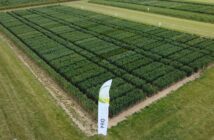
In the cover crop trial, three different mixes of cover crops were sown after the wheat crop in one-hectare blocks. The crops were drilled on 25 August with a Horsch Sprinter drill. There is also one block which Rob has managed using his normal method for spring establishment – it was cultivated and left over winter and will be drilled in spring.
The Leamington Monitor Farm group joined Rob and soil specialist Philip Wright to inspect the effect of the cover crops on 16 March. In two of the blocks, the cover crop established well and produced plenty of vegetation before being sprayed off on 5 February. On inspection, the soil in these areas was drier with roots penetrating down into the soil without restriction. According to Philip Wright these looked ready for drilling after a week or ten days – barring any prolonged rain.
In another block, a different, nitrogen fixing, cover crop mix didn’t establish as quickly because of the combination of plants. This lead to much wetter soil and seemingly less improvement of soil structure. The soil in this block was fairly similar to the area cultivated using Rob’s standard method.
“From the fields we looked at today we could clearly see some benefits from the cover crops where they had rooted well and produced vegetation. But it is all about the final yield, not how the soil looks or how it drills,” reiterates Rob.
Rob will continue to monitor this land even after this season as it has been observed that cover crops can lead to improvements in future crops. “We use yield maps across the farm so we will keep an eye on these blocks for a couple of years to see if there are any differences.”
Accepting Rob’s understandable caution, Philip Wright is a little more upbeat about the soils on the blocks where the cover crops established well: “The soil is in pretty good condition and should be ready to drill soon,” he says. So far these cover crops reflect Philip’s view that it is better to restructure soil using a root rather than a piece of metal, especially when soils are damp at the time.

AHDB Cereals & Oilseeds Monitor Farmer Rob Fox