
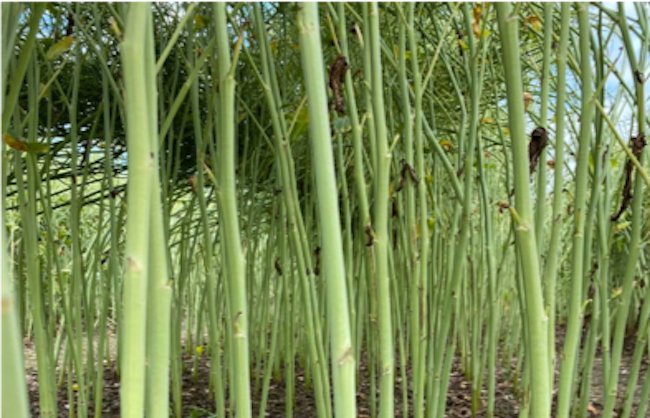
Don’t overlook the damage caused by stem-based diseases in oilseed rape is the warning from leading plant breeders Limagrain UK.
As the British climate trend moves towards warmer wetter weather, the risk to oilseed rape crops from the diseases of light leaf spot, phoma and verticillium stem stripe also increases. All three diseases can have a serious impact on oilseed rape yields and oil quality.
“With oilseed rape prices up at £700/tonne in late March, it’s crucial to keep the plant as healthy as possible if it has any chance of reaching its full yield potential, and this includes the health of the stem. A flat crop is of no use to anyone,” says Liam Wilkinson, arable technical officer for Limagrain UK.
“Over the last few years there has been much focus on canopy health in oilseed rape, but stem health is an area that is often overlooked and can have a serious impact on gross output.”
He points out that whilst phoma and Verticillium are generally well recognised stem-based diseases, the significance of their impact on UK OSR crops could be questioned.
“In recent years, phoma has become less of a problem with the use of resistant varieties. Verticillium stem stripe is a more sporadic disease, more closely linked to region, weather and crop factors,” he explains.
Mr Wilkinson considers light leaf spot (LLS) to be the biggest OSR disease threat in the UK, and is increasingly harder to control.
“Light leaf spot used to be considered to be a disease of the north, but this is no longer the case as mutations and a reduction in azole efficacy, alongside milder winter weather, has resulted in it spreading across the UK, with yield losses of up to 1 t/ha.”
“Often only considered to be a disease of the canopy, LLS infection can spread to the stem resulting in serious issues from stem distortion, stunting, poor pod formation and oil quality issues, and is often overlooked.”
Cylindrosporium is the stem-based stage of light leaf spot, a disease caused by the pathogen Pyrenopeziza brassicae. LLS is a polycyclic disease, producing more than one infection cycle per season, and Cylindrosporium concentricum is its asexual stage.
“Varieties offer good light leaf disease resistance ratings on the RL, but it’s important to recognise that in the UK, light leaf spot on the stem is not something that is scored for in the AHDB RL, it’s only the leaves that are scored for disease,” he says.
“Varieties with similar light leaf scores on the AHDB RL, will in reality have very different stem health scores.”
“So incidences of stem infection often go unreported, resulting in unnecessary yield and quality reductions.
“In France, stem based light leaf spot, or Cylindrosporium, is recognised to be a serious disease of oilseed rape in its own right and is included in the Terres Inovia Recommended List, the French equivalent of the AHDB RL.”
“But it’s been a key focus for us across the Limagrain European breeding programme. We select plants with good strong stems that stand well as a matter of course,” he adds.
All of the varieties currently on the RL have been scored for cylindrosporium in the Limagrain’s own trials, as well as for LLS in the RL programme. To illustrate this, Mr Wilkinson refers to Limagrain trials carried out in 2020.
“We evaluated the stem health of several varieties that all held the same light leaf spot score of 7 on the AHDB RL.(1= clean through to 9 which was fully diseased.)”
“Aurelia was scored an excellent score of 2 for overall stem health, Ambassador and LG Aviron scored a very good 3, but one variety only scored a 6 despite also holding a light leaf spot rating of 7!
“The important message here is to look behind the headline scores and
don’t assume that a good overall light leaf spot score translates into a good stem health score.”
Now in its 7th generation of bringing trait loaded hybrids to the market place, the Limagrain breeding program has made Stem Health a key focus, he notes.
“The next generation of Limagrain lines are looking really clean for all the major stem-health diseases. These will begin to appear on the UK market this autumn, and will be more widely available in 2023.”
Limagrain UK’s oilseed rape varieties continue to dominate the 2022/23 AHDB Recommended List 2022/2023 (RL) with nine of the top ten varieties on the UK List.
“Limagrain’s oilseed rape varieties have now held the top positions on the RL consistently for three years which reflects the success of our ‘trait loaded’ breeding approach in bringing varieties to market that are resilient and perform consistently” says Liam Wilkinson, Limagrain’s technical development officer.
“It’s worth recognizing that in order to earn a place on the UK List, a variety must have shown itself to offer the top gross output and agronomics across a wide range of geographical locations from east to west and as far north as Scotland, across several different seasons, he points out.
“For a variety to do this is the hall mark of yield stability and really is quite an achievement.”